About Rubus schmidelioides A.Cunn.
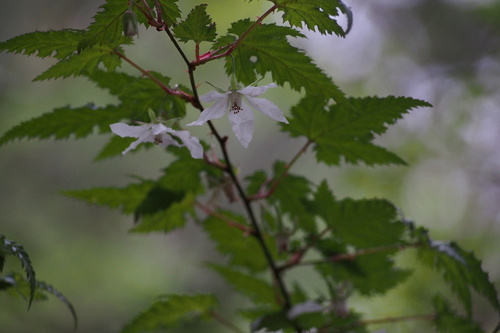
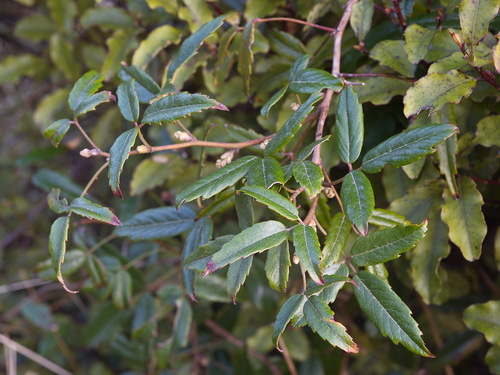
Rubus schmidelioides A.Cunn. is a perennial dicot that grows as either a dense intertwining liana or shrub. As a liana it can reach up to 10 metres in length, while it forms a shorter bush when no supporting structure is available. It climbs up host plants using small reddish hooks along its stems; stems are long, tapering, and can grow up to 10 cm in diameter. Its leaves are glossy, with colour ranging from orange to green to brown, and arranged in a compound palmate pattern with 3 to 5 leaflets. This species produces domatia on its leaves. Leaflets are terminal, with oval, oblong, or lanceolate shapes, a distinct midrib, and serrated margins. The underside of the leaf is grey-white: the upper surface of leaflets is hairless, while the underside is covered with hairs that can be white, brown, or grey. Leaves often curl downwards. Leaflets typically measure 2–6 cm long and 2.5–3.5 cm wide, and their petiolules average 10–50 mm long. Branchlets can reach up to 40 mm in diameter; young branchlets are covered in short soft hairs, while mature branchlets become hairless, smooth, and develop large red spikes. This species has small narrow stipules, and petioles that are 20 mm long. Juvenile plants have narrower, more hairless leaflets than mature plants, but mature plants growing in open scrubland retain their juvenile leaves. This growth variant is classified as Rubus schmidelioides var. subpauperatus. Populations of R. schmidelioides growing on the Chatham Islands have average larger leaves than populations from mainland New Zealand. Inflorescences grow on a 10 mm long smooth branchlet that has no spikes. Flowers are white aggregates, each with five petals. Sepals are 2 mm long, while petals measure 4–7 mm long; petals are white or cream, oval-shaped, and typically 5–7 mm long. Full inflorescences are usually 10–25 cm long. The fruit is yellow or orange yellowish, formed by 8 to 12 aggregated drupelets. Fruits measure 5–9 mm in diameter, and are typically 5–7 mm long. R. schmidelioides can be easily distinguished from other introduced Rubus subspecies by its much smaller flowers and the absence of long hairs on its stems, which other common Rubus species have. Its red-coloured stem spikes also make them much more visible than those of related species. Both R. schmidelioides var. schmidelioides and the variant var. subpauperatus are endemic to New Zealand and the Chatham Islands. It occurs mainly in eastern Canterbury of the South Island, but can also be found in other areas of the country, including Stewart Island. The species is primarily found in scrub and forest. Its variant R. schmidelioides var. subpauperatus occurs in open scrublands or exposed rocky sites. It has previously been recorded in the driest vegetation zones surrounding lakes, and in a freshwater wetland near the Waitangiroto River. R. schmidelioides grows best during mid-succession, before tree canopies have grown tall. Juvenile plants struggle to grow in low light under an already established canopy. It favours environments with alluvial soils, and is more common in indigenous forests. R. schmidelioides flowers from September to November; its white flowers hang in long panicles. It fruits from December to April. It is dioecious, producing separate male and female flowers. Male flowers have numerous stamens, and an ovary that is either absent or underdeveloped. Female flowers have rudimentary stamens and multiple carpels. After fertilization, an endocarp-enclosed seed forms. Seeds must pass through harsh conditions such as a bird's digestive tract before they can germinate. Seeds also require a month of cool stratification at around 3°C to sprout. Early European settlers in New Zealand called this plant tātarāmoa, and noted its berries resembled European wild blackberries. They used its berries to make foods such as preserves and jams.