About Rubus rosifolius Sm.
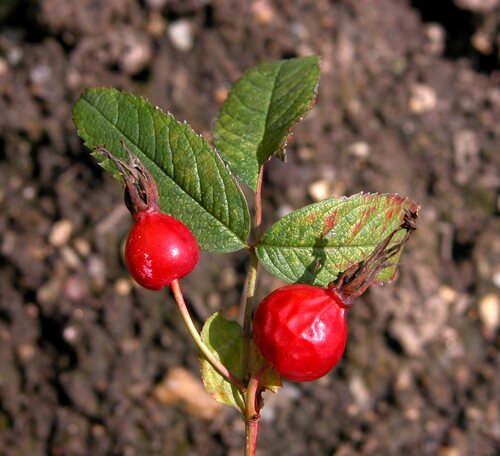
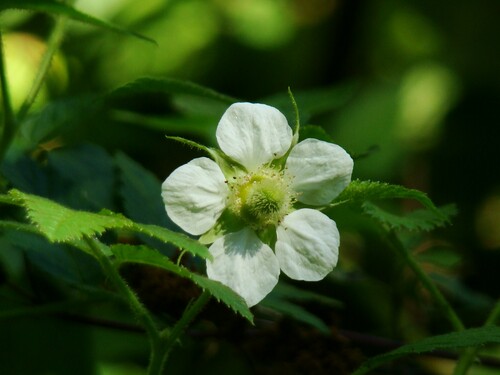
Roseleaf bramble, scientifically Rubus rosifolius Sm., is a shrub with straight or arching stems that can grow up to 2.5 meters (8.2 ft) tall. Its stems are covered in long, spreading white hairs, with scattered amber-green glands that may be dense in small patches. This species has compound leaves with toothed margins, and glandular hairs cover both sides of its leaflets. Its flowers are white, and grow either in panicles or as solitary blooms. The fruit of this plant reaches 2 cm in length. This species is native to India, Southeast Asia, and some islands of the western Pacific. It has been widely introduced to parts of Australia, Africa, South America, Central America, and other Pacific islands. Within its native range, it extends west to Nepal, Sri Lanka, and India. In India, it occurs mainly in the northeast, in the states of Arunachal Pradesh, Assam, Manipur, Meghalaya, Mizoram, Nagaland, Sikkim, Tripura, and West Bengal; it is also native to Himachal Pradesh and Uttarakhand in northwest India, and Tamil Nadu in southern India. To the east, it is native to all mainland Southeast Asian countries except for Singapore. In China, it is primarily native to the southeast, occurring in Anhui, Fujian, Guangdong, Guangxi, Hubei, Hunan, Jiangxi, and Zhejiang; in southern China its native range extends west to Guizhou, Sichuan, and Yunnan, and north to Shaanxi. It is also native to the island of Taiwan. It is native to many Indonesian islands, including Borneo, Sulawesi, and both the western and eastern portions of New Guinea. Rubus rosifolius has become naturalized in eastern Australia and New Zealand. It has escaped from cultivation or been intentionally introduced to many islands, including Vanuatu, New Caledonia, Hiva Oa in the Marquesas Islands, the Hawaiian Islands, Tahiti, Moʻorea, Raʻiātea, Rapa Iti, Ascension Island, and St. Helena. It also grows abundantly in the Brazilian states of Minas Gerais, Rio de Janeiro, and areas south as far as Rio Grande do Sul. It naturally grows in rainforests and tall open forests. Although it is rarely cultivated, the plant has several uses. When grown in soil with good moisture, its fruit has a sweet, pleasant flavor. The fruit is sold at local markets in the Himalayas. Its leaves are used to make a medicinal herbal tea that treats diarrhoea, menstrual pains, morning sickness, and labour pains, and the leaves contain essential oils.