About Rubus phoenicolasius Maxim.
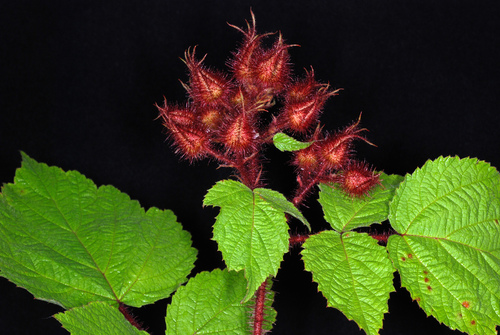
Rubus phoenicolasius Maxim., commonly called wineberry, is a perennial plant that grows biennial stems called canes from a permanent perennial root system. In the first year of growth, a new unbranched stem called a primocane grows vigorously to its full height of 1–3 meters. It produces large pinnate leaves with three or five leaflets, and typically does not produce any flowers in this first year. In its second year, the stem, now called a floricane, stops growing taller, and produces several side shoots. These side shoots bear smaller leaves that always have three leaflets, and the undersides of these leaves are white. Flowers grow in late spring on short, very bristly racemes at the tips of these side shoots. Each flower is 6–10 millimeters in diameter, with five purplish red to pink petals and a bristly calyx. The fruit, which ripens starting in early summer, is orange or red, about 1 centimeter in diameter, and edible; it is produced in summer or early autumn. Like all species in the genus Rubus, this fruit is botanically classified as an aggregate fruit made of numerous small drupelets surrounding a central core, not a true berry. The canes are covered in red glandular hairs; these red hairs give the species its scientific name, from the Latin phoenicus, which means red. Besides reproducing via seed, new wineberry plants also grow from the tips of existing canes that touch the ground. Wineberries thrive in moist soil and grow near and within wooded areas. As a fruit develops, it is surrounded by a protective calyx covered in hairs that secrete tiny drops of sticky fluid. While this structure resembles the trapping structures of carnivorous plants, wineberry does not get nutrients from insects caught in this sticky fluid. The sticky mucilage does not contain any digestive enzymes, surrounding plant tissues cannot absorb nutrients, and wineberry has no protein-storage tissues that would process captured insect nutrients. Unlike true carnivorous plants, wineberry grows in nutrient-rich soil and does not need to obtain nitrogen from insect proteins. All leaves, stems, and branches of the plant are covered in spines. Leaves grow in sets of three: the two side leaves are small, while the center leaf is large. Leaves are green on their upper surface and white on their lower surface, due to a dense layer of woolly hairs. Wineberries grow wild in many parts of the United States, primarily in the Appalachian Mountains. They are common along the edges of fields and roadsides, and are still used as breeding stock for raspberry cultivars. They are edible, and have no poisonous look-alikes in North America. Other edible plants that people may mistake for wineberries include red raspberry, salmonberry, black raspberry, and blackberry. Wineberries have a sweet and tart flavor similar to raspberry. They can be eaten raw, or used in the same ways as raspberries to make pastries like pie and other sweet treats.