About Rubus parviflorus Kük.
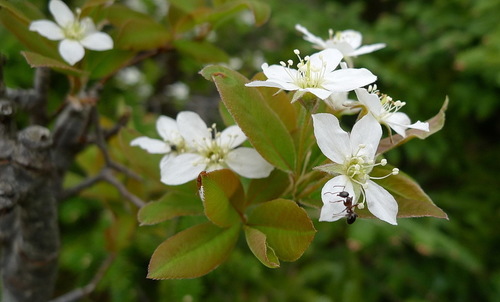
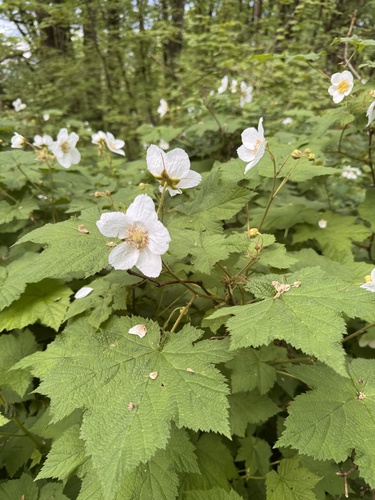
Rubus parviflorus is a dense shrub that grows up to 2.5 meters (8 feet) tall, with canes that reach no more than 1.5 centimeters (1⁄2 inch) in diameter. It often forms large clumps that spread via the plant’s underground rhizome. Unlike many other species in the Rubus genus, it has no prickles. Its leaves are palmate, up to 20 cm (8 in) across, which is much larger than leaves of most other Rubus species. The leaves have five lobes and a soft, fuzzy texture. Its flowers are 2 to 6 cm (3⁄4 to 2+1⁄4 in) in diameter, with five white petals and numerous pale yellow stamens. The flowers of this species are among the largest of any Rubus species. The plant produces an edible composite fruit approximately 1 cm (1⁄2 in) in diameter, which ripens to a bright red in mid to late summer. Like raspberries, it is not a true berry, but instead an aggregate fruit made of many drupelets arranged around a central core. When harvested, the drupelets can be carefully removed intact separately from the core, leaving a hollow fruit that resembles a thimble, which likely gave the plant its common name. Rubus parviflorus is native to western North America, ranging from Alaska in the north south to California, New Mexico, Chihuahua, and San Luis Potosí. Its range extends east to the Rocky Mountains, and continues discontinuously into the Great Lakes Region. It grows from sea level in the northern part of its range, up to elevations of 3,000 m (10,000 ft) in the south. This species typically grows along roadsides and railroad tracks, and in forest clearings. It commonly appears as an early part of ecological succession in clear-cut areas and areas after forest fires. Thimbleberry grows in forest understories, where its typical flora associates include coastal woodfern (Dryopteris arguta), Trillium ovatum, and Smilacina racemosa. In its ecology, the fruit of Rubus parviflorus is eaten by birds and bears, while black-tailed deer browse its young leaves and stems. Larvae of the wasp species Diastrophus kincaidii, known as the thimbleberry gallmaker, develop inside large, swollen galls that form on the plant’s stems. An aphid from the genus Masonaphis induces galls on the plant’s leaves, and a midge from the genus Dasineura induces galls on the plant’s petioles. Rubus parviflorus is cultivated by specialty plant nurseries as an ornamental plant. It is used in traditional gardens, native plant gardens, wildlife gardens, natural landscaping design, and habitat restoration projects. Its fruit has a fragrance. Thimbleberry plants can be propagated most successfully by planting dormant rhizome segments, and can also be propagated from seeds or stem cuttings. Its flowers support pollinators, and are of special value to native bees, honeybees, and bumblebees. The fruit is attractive to a variety of birds and mammals, including bears. It serves as a larval host and a nectar source for the yellow-banded sphinx moth. Many parts of this plant were used in folk medicine by Native Americans. A tea made from its leaves or roots was thought to treat wounds, burns, acne, and digestive problems, while a tea made from its canes was thought to work as a diuretic. As of 2019, there is no evidence from modern clinical research or practice that Rubus parviflorus is effective for treating any disease. Thimbleberry leaves can be used as a replacement for toilet paper when in the wilderness.