About Rubus occidentalis L.
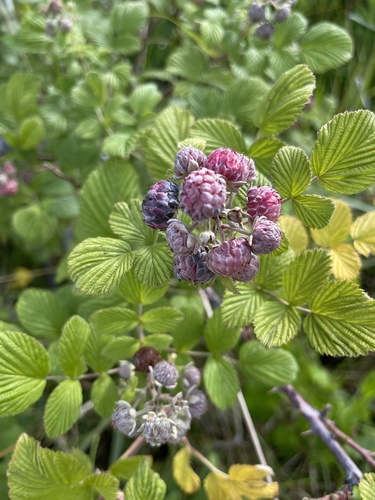
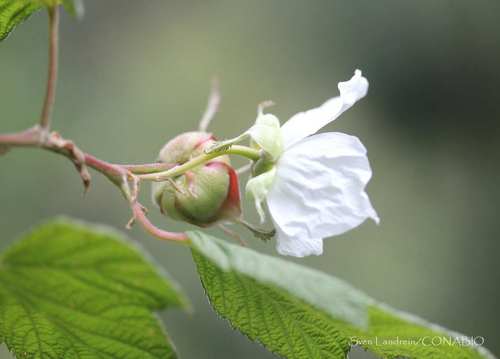
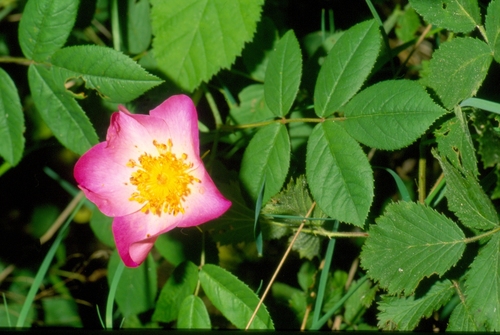
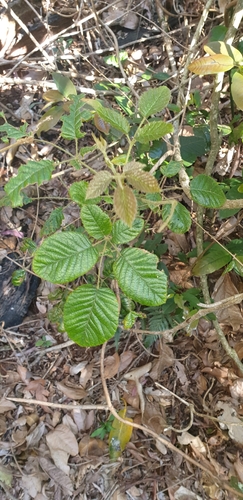
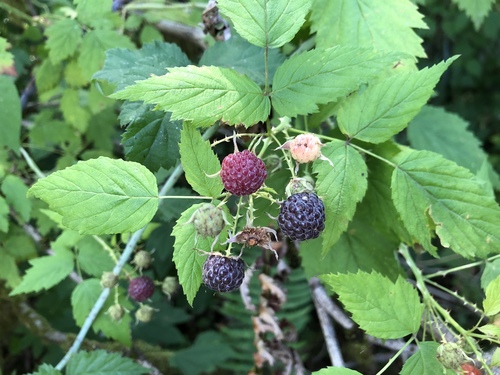
Rubus occidentalis L., commonly known as black raspberry, is a deciduous shrub that reaches 2 to 3 metres (6+1⁄2 to 10 feet) in height. Its leaves are pinnate: leaves on strong-growing first-year stems have five leaflets, while leaves on flowering branchlets have three leaflets. Its flowers are distinguished by long, slender sepals that measure 6 to 8 mm (1⁄4 to 5⁄16 in) long, more than twice the length of the plant's petals. The fruit is round, a 12-to-15-millimetre-diameter (1⁄2 to 9⁄16 in) aggregation of drupelets. It is edible, and contains high levels of anthocyanins and ellagic acid. The plant's long stems, also called canes, grow up to 1.8 metres (5 ft 11 in) in length. They usually form an arch, though some grow upright. Canes bear curved, sharp thorns; immature unbranched canes have a whitish bloom. This species is related to the red raspberries Rubus idaeus and Rubus strigosus, sharing with them the characteristic white underside of leaves and fruit that easily detaches from the carpel. It is also closely related to Rubus leucodermis, which is also called black raspberry or blackcap. This plant grows in disturbed areas, particularly logged or cut sites, and can also be found in meadows, and near streams, lakes, trails, and roadways. Its native range in North America reaches east to New Brunswick, west to Nebraska, north to Quebec, and south to Mississippi.