About Rubus hawaiensis A.Gray
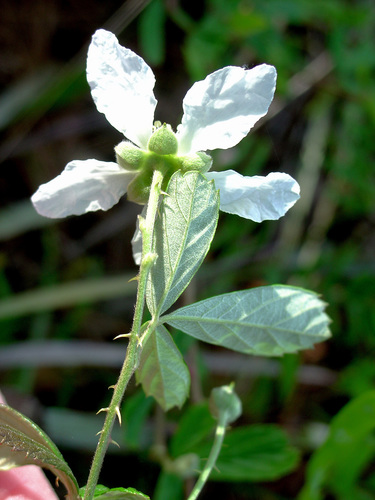
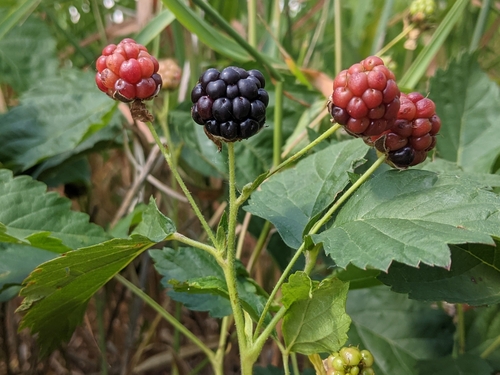
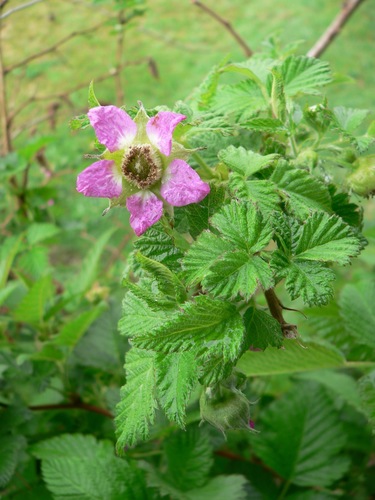
Rubus hawaiensis A.Gray is a deciduous shrub that usually grows in clumps of erect canes; longer canes take on an arching shape, and reach 1.5–3 m (4.9–9.8 ft) in length. Its leaves are compound, with three leaflets each. It produces large red fruit that measures up to 4 cm (1.6 in) long and 2.5 cm (0.98 in) wide. The fruit is edible but is not commonly eaten because it has a sour, somewhat bitter taste. While this species is often described as prickle-free (thornless) and cited as an example of defense loss in island plants, most individual plants do have thin prickles, at least when they are young. As the cane matures, its outer bark layer typically sheds, and the prickles are shed along with the bark. Interest in breeding thornless varieties of edible raspberries, which may even involve crosses with distantly related species because most Rubus species hybridize easily, has led to the introduction of several continental Rubus species. Many of these introduced species have escaped cultivation and become invasive pests. Two of these problematic introduced species are the yellow Himalayan raspberry, Rubus ellipticus, and the Florida prickly blackberry, Rubus argutus.