About Rubus flagellaris Willd.
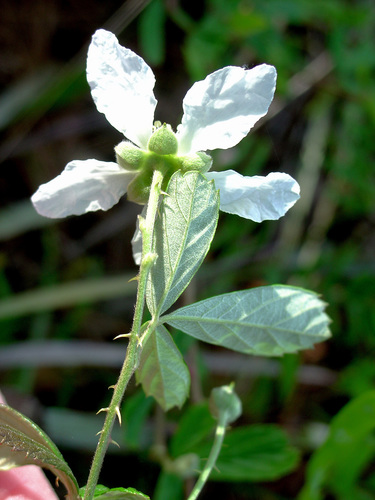
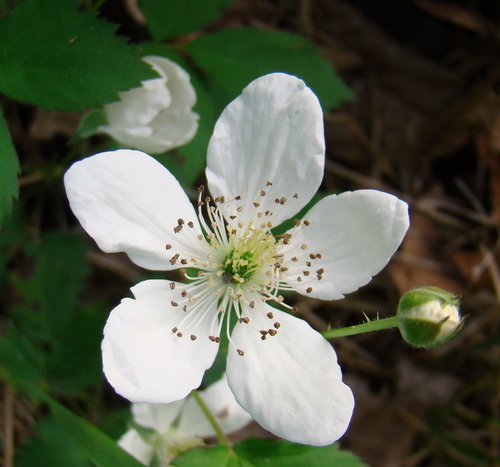
Rubus flagellaris Willd., commonly called northern dewberry, produces low-growing stems that measure 8–15 feet (2.4–4.6 m) long, while its flowering stems can reach up to 4 feet (1.2 m) in height. It grows as either a woody vine or a low-growing shrub. Young stems are green and bear scattered hairy prickles, while old stems are brown and woody, with harder prickles than those on young stems. Tips of young stems sometimes root into the ground to form new vegetative offsets. The species sees its most active growth between mid-spring and early summer, and it has a woody taproot. This plant has alternate compound leaves, most often with three leaflets per leaf, though five leaflets sometimes occur. Leaf margins are serrated, and leaves show palmate venation. Each leaflet is ovate, roughly three inches (75 mm) long and one inch (25 mm) wide; leaflets are dark green on their upper surface and pale green on the underside. One leaflet in each set connects to the stem via a petiole, and the other leaflets in the set connect to this terminal leaflet. The plant produces five-petaled white flowers around one inch (25 mm) in diameter. Flowers form a terminal inflorescence, with one to five flowers per young stem. Flowers are hermaphroditic, with both male and female sex organs. They have five green, lanceolate sepals, and the ovary sits superior to the sepals and petals. Multiple stamens surround a cluster of carpels. Flowers open during the day and close at night. After fertilization, drupes develop in place of each flower. These drupes are dark purplish and measure ½ inch to one inch in diameter, and fully ripe fruit has a tart-sweet flavor. Rubus flagellaris is native to the central and eastern United States (ranging from Texas, Oklahoma, Kansas, and Nebraska to the Gulf Coast, East Coast, and Great Lakes region), eastern Canada (Ontario, Quebec, New Brunswick, and Nova Scotia), and northern Mexico (Coahuila, Hidalgo, Nuevo León, San Luis Potosí, Sonora). It grows in dry soils, bogs, soft soils, and wooded soils, and is particularly adapted to coarse-textured soils such as sandy soil, fine-textured soils such as loamy soil, and medium-textured soils such as clay-textured soil. It occupies a wide range of habitats, including mesic to dry savannas, sandy savannas, abandoned fields, wooded meadows, and woodland borders. It is adapted to annual precipitation ranging from 15 to 40 inches, tolerates soil pH between 5.0 and 7.0, and can survive temperatures as low as −23 °F (−31 °C). Compared to other species with similar growth habits in its natural regions, this species has low drought tolerance, intermediate shade tolerance, and no salinity tolerance. Many mammals including raccoons, fox squirrels, eastern chipmunks, and white-footed mice eat the fruit of Rubus flagellaris and help disperse the species. It has a high tolerance to hedging from livestock and wildlife browsing. The fragrant nectar of Rubus flagellaris flowers attracts many native bees, and the plant also provides nesting materials and structures for native bees. Bee species that visit and pollinate the plant include mason bees (genus Osmia), leaf-cutting bees, cuckoo bees (subfamily Nomadinae), and miner bees. Other insects that interact with and pollinate northern dewberry are Siphonopora rubi (blackberry aphid), Metallus rubi (blackberry leafminer), Agrilus ruficollis (red-necked cane borer), and Edwardsiana rosae (rose leafhopper). The flowers are also a preferred nectar source for the Karner blue, an endangered blue butterfly found in the Midwestern U.S. and northeastern North America. When occasional wildfires burn the tall woody trees surrounding Rubus flagellaris, this burning has a positive effect on the species' population growth, and additional research confirms that occasional wildfires benefit the species' population growth. Ripe berries of Rubus flagellaris are edible raw, and are also used to make preserves, pies, and cobblers.