About Rubus ellipticus Sm.
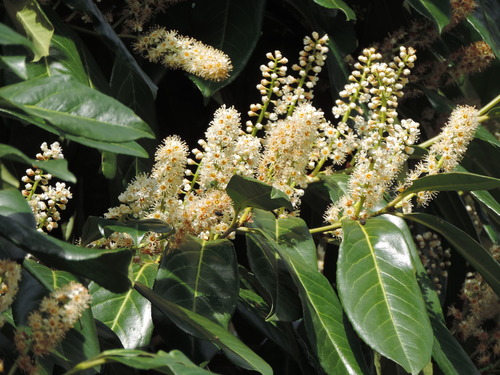
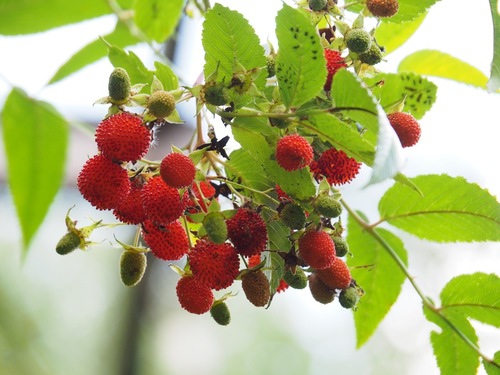
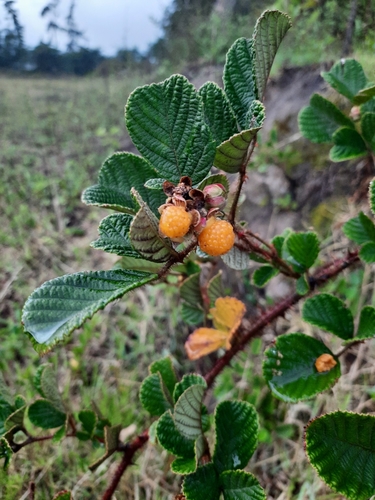
Rubus ellipticus Sm., commonly called the golden Himalayan raspberry, is a large shrub with stout canes that reach up to 4.5 metres (15 ft) long. Its leaves are trifoliate, made of three elliptic or obovate leaflets that typically grow 5 to 10 cm long. The leaves are green, with a lighter underside, and their surface is covered in downy hairs. Its small flowers each have five white petals, and grow in multi-flower clusters. In the Himalayas, this species typically blooms from February to April. On the slopes of Mount Gede, on the western side of Indonesia's Java island, it can flower every three months, with a peak flowering season in April. Its fruits are sweet, detachable, and highly sought after by birds and Asian elephants. The plant's fruit has a sweet taste, but it is not commonly harvested for domestic use, and perishes quickly after being picked from the thorny bush. The golden Himalayan raspberry is native to the temperate Himalayas region, and its native range includes India, Pakistan, Nepal, southern China, Assam, Laos, Myanmar, the Philippines, Sri Lanka, Thailand, Tibet and Vietnam. In the higher reaches of Himalayan Indian states such as Himachal and Uttarakhand, it grows as a weed in open grasslands and is rarely found in forests, at an altitude of 1,500 to 2,100 m (4,900 to 6,900 ft). It is often found in the region's pine forests, and can also grow in mesic or wet forests. It has adapted to grow in both full shade and full sun exposure. Like other Rubus species, its seeds are readily distributed by birds. It can reproduce asexually (propagate) through cuttings. It can grow in open fields and in the canopies of moist forests. Its rotting fruit supports large populations of Drosophila (fruit flies). For human uses, Nepali farmers have had limited success harvesting and fermenting this fruit (called aiselu) to make fruit wine. In Sikkim, the plant's roots are used to treat stomach pain and headaches, and its fruits are used to treat indigestion. In Tibetan villages, the plant's bark is used for medicinal purposes, primarily as a renal tonic and an antidiuretic. Its juice is used to treat coughs, fevers, colic, and sore throat. The plant can also be used to make a bluish-purple dye. The fruits of the golden Himalayan raspberry are recorded as a rich source of phenolics, beta carotenes, ascorbic acid (vitamin C), many other important metabolites, and antioxidants. Its leaves also contain various beneficial properties. Fruit extracts of R. ellipticus have been found to have antimicrobial properties (Ding et al. 2008).