About Rubus cissoides A.Cunn.
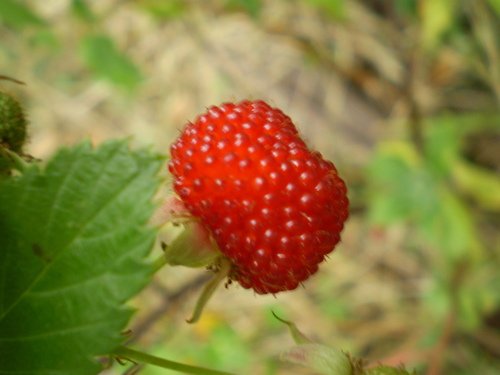
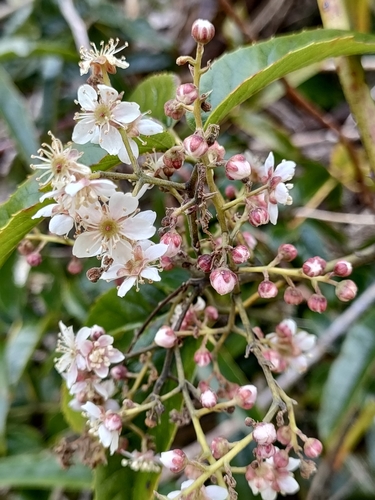
Rubus cissoides A.Cunn. are dioecious vines that grow up to 10 m long, scrambling or climbing over other vegetation. Young stems are covered in hooked reddish prickles, particularly on the underside, while mature stems are hairless and lack prickles. Its leaves are either palmately or ternately compound, smooth and hairless. Young plants produce up to 5 long, narrow leaflets, and mature plants produce 3 to 5 leaflets. Both petioles and petiolules bear hooked prickles. Leaflets vary in size and shape, measuring 6 to 15 cm long and up to 6 cm wide. They are lanceolate or oblong, with sharply toothed edges and pointed tips. The inflorescences are large, much-branched panicles of white flowers that can reach 20 cm in length. Each flower has 5 sepals and 5 petals, and the species is dioecious: male flowers have numerous stamens, but no style or only a rudimentary style; female flowers have a functional style, but no stamens or only a few rudimentary stamens. Its berries are around 1 centimetre in diameter, yellow to red, and composed of approximately 10 to 15 drupelets. This species is endemic to New Zealand, where it is widespread across all three main islands: the North Island, South Island, and Stewart Island. It grows in lowland and montane habitats, most often in forests, but also in scrub and wetland margins, typically in moist, sunny environments. In a seed germination experiment, 82% of Rubus cissoides seeds successfully germinated. Some seeds germinated in spring, while the remaining seeds germinated slowly and steadily over the course of two years. Young plants spread across the forest floor until they find a suitable shrub or other vegetation to use for support. They can grow upright to around 60 cm without external support before they need to climb on other vegetation. Rubus cissoides is insect-pollinated. It flowers from September to November, and produces fruit from December to April. Rubus cissoides and other native New Zealand Rubus species were used by Māori, and still hold multiple uses today as food, construction materials, and medicines. Both birds and people eat its fruits, its branches can be used to make traps, and crushed berries produce a blue or purple dye. Māori traditional medicinal uses for these plants include using stem bark to treat abdominal pains, root bark to treat diarrhea, and prepared crushed leaves to relieve chest congestion and colds.