About Rubus argutus Link
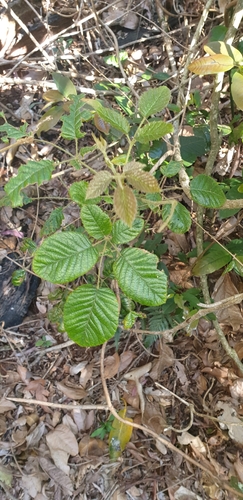
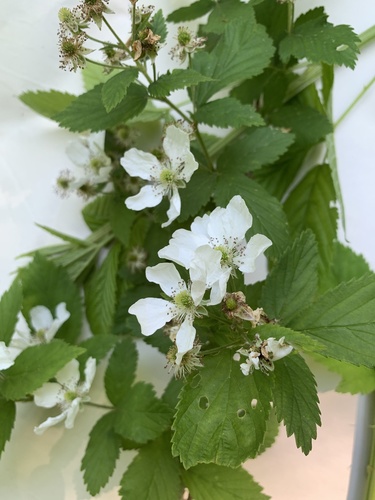
Rubus argutus Link typically grows as a woody shrub or vine reaching up to 2 metres (6+1⁄2 ft) tall, and bears thorns on its stems, leaves, and flowers. Its leaves are alternate and palmately compound. First-year individuals have palmate leaves with 5 leaflets, while second-year plants have palmate leaves with 3 leaflets. Second-year plants produce racemes of flowers, each holding 5 to 20 flowers. The flowers are generally 5-merous, with large white petals and light green sepals, and bloom in mid-spring. Only second-year plants produce fruit, which gives the species its common name of blackberry. The fruits are compound drupes that turn from bright red to black when mature. Each individual drupelet section of a blackberry holds one seed. Second-year plants die after producing fruit, but new growth regrows from the plant’s underground structures. This species grows across a range from Florida to Texas, Missouri, Illinois, and Maine. It is one of multiple species that produce edible blackberries, which vary in size among species. Blackberry leaves from this plant were once listed in the official U.S. pharmacopoeia, and were reported to treat digestive issues, especially diarrhea. Dried leaves of Rubus argutus can be used to make an excellent tea.