About Rubroboletus satanas (Lenz) Kuan Zhao & Zhu L.Yang
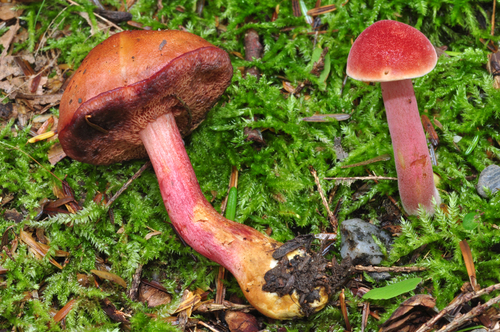
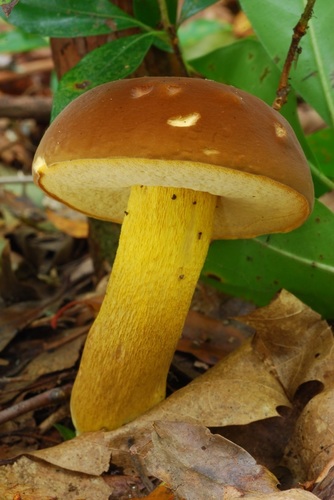
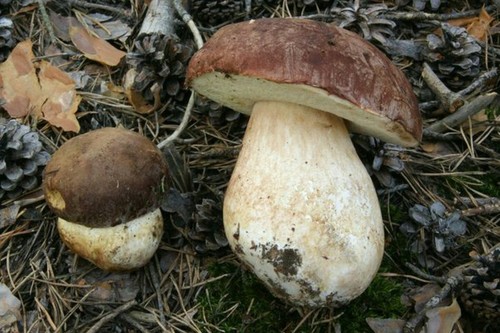
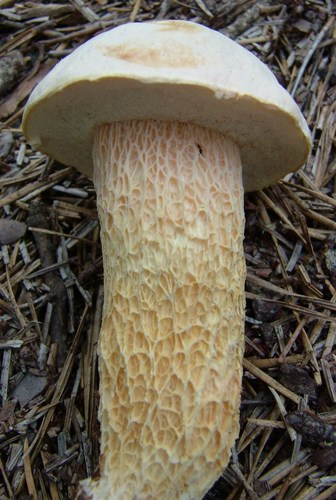
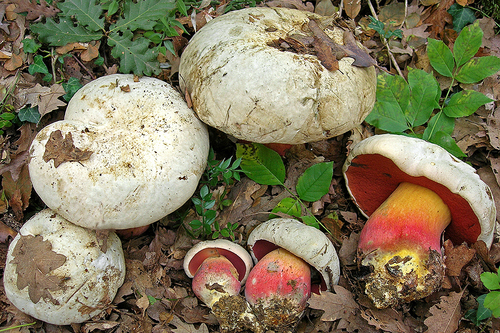
Rubroboletus satanas (Lenz) Kuan Zhao & Zhu L.Yang is often described as the largest bolete found in Europe. Its compact cap can reach an impressive 30 cm (12 in) in diameter, exceptionally 40 cm (16 in), and very rarely 50 cm (20 in). When young, the cap is hemispherical with an inrolled margin; it becomes convex at maturity as the fruit body expands, and older specimens may have a slightly undulating margin. Young pilei are greyish white to silvery-white or buff, while older specimens develop olivaceous, ochraceous, or brownish tinges. The cap surface is finely tomentose, becoming smooth at maturity and often slightly viscid in wet weather. The cap cuticle is tightly attached to the flesh and cannot be peeled. The tubes are free to slightly adnate, up to 3 mm (1⁄8 in) long, pale yellow or greenish yellow, and turn blue when cut. The rounded pore openings are yellow to orange at first, then turn red starting from their attachment to the stem and spreading outwards, eventually becoming entirely purplish red or carmine-red at full maturity; they instantly turn blue when touched or bruised. The stipe is 5–15 cm (2–6 in) long, extraordinarily 20 cm (8 in), very rarely 25 cm (10 in). It is distinctly bulbous, measuring 4–12 cm (1.6–4.7 in) across at its widest point, extraordinarily 16 cm (6.3 in), very rarely 20 cm (7.9 in), and is often wider than it is long. As the fungus expands, the stipe becomes more ventricose but remains bulbous at the base. It is golden-yellow to orange at the apex, becoming increasingly pinkish-red to reddish-orange further down, and deep carmine-red to purple-red towards the base. It is covered in a fine, yellowish to reddish hexagonal net, which is sometimes confined to the upper half of the stipe. The flesh is thick, spongy, and whitish, though it may be yellow to straw-coloured in immature specimens and sometimes reddish at the stem base. When cut, it slowly turns a faded blue, with more intense bluing around the apex and above the tubes. Young fruit bodies have a weak, pleasantly musky smell, which becomes increasingly putrid in older specimens, reminiscent of carrion. Young specimens are reported to have a pleasant, nutty taste. The spore print is olivaceous green. Under a microscope, spores are fusiform (spindle-shaped), measuring 10–16 × 4.5–7.5 μm. The cap cuticle is made of interwoven septate hyphae that are often finely incrusted. Rubroboletus satanas is widely distributed throughout the temperate zone, but is rare in most of its reported localities. In Europe, it mostly occurs in southern regions, and is rare or absent in northern countries. It fruits in summer and early autumn in warm, broad-leaved and mixed forests, forming ectomycorrhizal associations with oak (Quercus) and sweet chestnut (Castanea), and prefers calcareous (chalky) soils. Other frequently reported host trees are hornbeam (Carpinus), beech (Fagus), and lime/linden trees (Tilia). In the United Kingdom, this striking bolete is found only in southern England. It is rare in Scandinavia, occurring primarily on a few Baltic Sea islands with favourable conditions and highly calcareous soil. In the eastern Mediterranean, it has been recorded in Bar'am Forest in the Upper Galilee region of northern Israel, and on the island of Cyprus, where it grows in association with the narrow-endemic golden oak (Quercus alnifolia). It has also been documented in the Black Sea and eastern Anatolia regions of Turkey, as well as Crimea and Ukraine, and its distribution may extend as far south as Iran. In the past, R. satanas was reported from the United States, but these sightings actually refer to the closely related species Rubroboletus eastwoodiae. This mushroom is moderately poisonous, especially when eaten raw. Poisoning symptoms are predominantly gastrointestinal, including nausea, abdominal pain, and violent vomiting with bloody diarrhea that can last up to six hours. The toxic enzyme bolesatine has been isolated from R. satanas fruiting bodies and is linked to its poisonings. Bolesatine is a protein synthesis inhibitor, and when administered to mice, it causes massive thrombosis. At lower concentrations, bolesatine is a mitogen that induces cell division in human T lymphocytes. Muscarine has also been isolated from this fungus, but its quantities are thought to be far too small to cause toxic effects in humans. More recent studies have linked R. satanas poisoning to hyperprocalcitonemia, and have classified it as a distinct syndrome among fungal poisonings. Controversially, English mycologist John Ramsbottom reported in 1953 that R. satanas is consumed in parts of Italy and the former Czechoslovakia. In these regions, people reportedly eat the fungus after prolonged boiling, which may neutralise its toxins, though this has never been scientifically proven. Similar reports exist from the San Francisco Bay Area of the United States, but these almost certainly involve a different fungus misidentified as R. satanas. Ramsbottom speculated that there may be regional variation in its toxicity, and conceded that the fungus may not be as poisonous as widely reported. Even so, R. satanas is rarely collected casually, not least because of its foul smell; along with its bright red colour and blue staining, this makes the fungus unappealing for human consumption.