About Rubroboletus rubrosanguineus (Cheype) Kuan Zhao & Zhu L.Yang
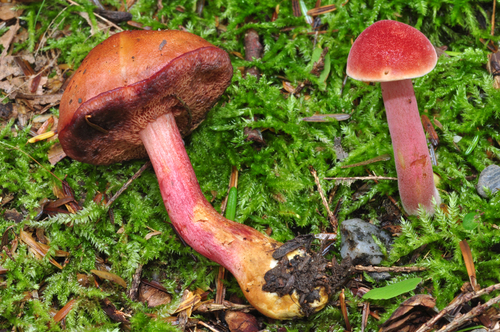
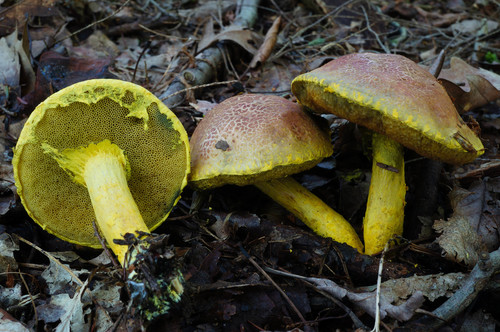
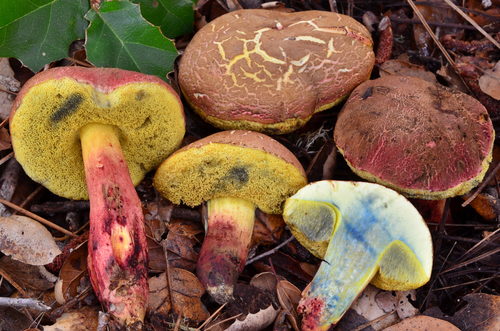
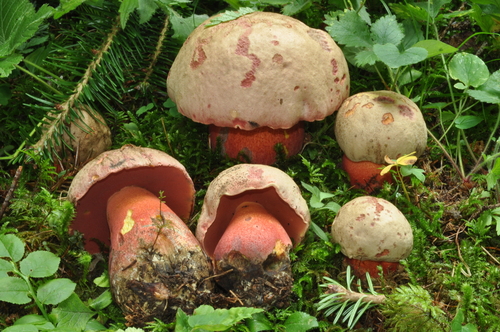
This fungus produces large, stout fruit bodies with caps ranging from light to dark grey or grey-brown. Caps often have pinkish margins, and can grow up to 15 cm (6 in) in diameter. Young caps are initially hemispherical (dome-shaped), becoming convex to flat as the fungus matures. It has red pores, yellow tubes, and pale yellow flesh; all of these structures turn blue when bruised. The stout stipe is either bulbous or cylindrical at the base, yellow at the top, and pink to orange-red on its lower portions. It is patterned with fine darker orange or red reticulation. Both fresh and dried mushrooms of this species have a hay-like odor. Rubroboletus rubrosanguineus closely resembles the related species Rubroboletus legaliae, which differs by growing in deciduous forests. This species is mycorrhizal, forming symbiotic associations with spruce (Picea) and fir (Abies) trees. It occurs in eastern Europe, ranging east as far as the Caucasus, and is typically found in montane habitats. It is classified as critically endangered on the Red List of fungi of the Czech Republic.