About Rubroboletus rhodoxanthus (Krombh.) Kuan Zhao & Zhu L.Yang
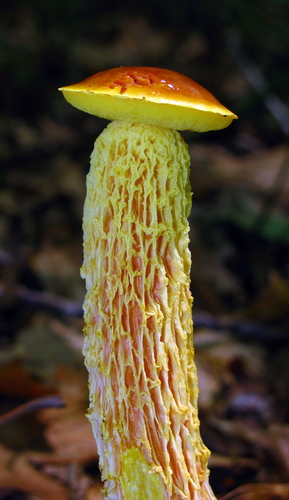
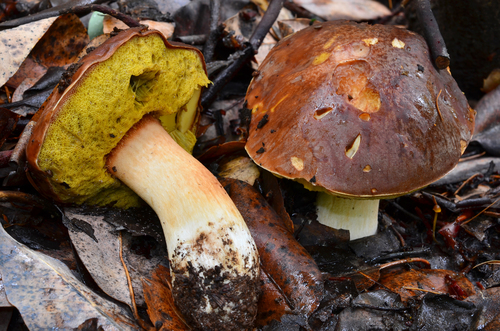
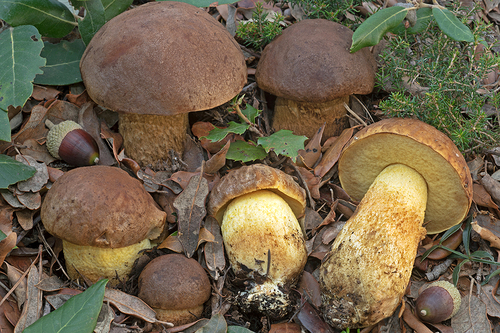
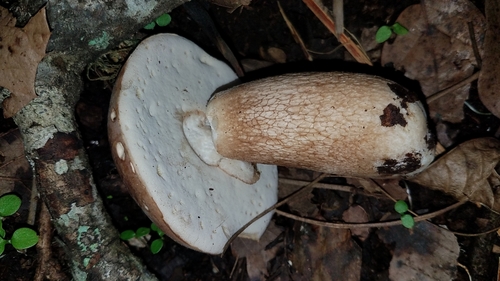
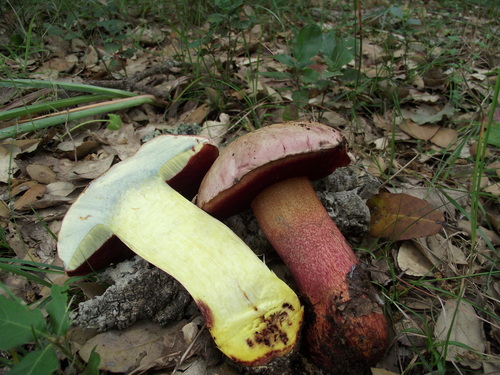
Rubroboletus rhodoxanthus is a species of bolete fungus with the scientific authority (Krombh.) Kuan Zhao & Zhu L.Yang. The cap is initially hemispherical, and gradually becomes convex to almost flat as the fungus grows. It typically reaches 10 to 20 cm (4 to 8 in) in diameter, and may occasionally grow up to 30 cm (12 in). Young caps are slightly velvety and mostly whitish-grey, but they soon become smooth and change to pinkish-grey, pinkish-beige, or pinkish-red — this color change is especially prominent near the margin, or when the cap is handled. The tubes are adnate to emarginate, and measure 0.5 to 1.5 cm (0 to 0.5 in) long. They start out yellow, and develop an olivaceous-yellow tone in very mature fruit bodies, and stain blue when cut. The pores (tube mouths) are orange to deep red, and turn blue immediately when handled. The stem is 8 to 12 cm (3 to 4.5 in) long and 3 to 6 cm (1 to 2.5 in) wide. It is bulbous or club-shaped when young, and becomes more elongated and cylindrical when mature. The top (apex) of the stem is orange or orange-yellow, fading to orange-red to carmine-red toward the lower section, and has a dense, orange-red to carmine-red reticulation (a network-like pattern). The flesh is distinctly bright yellow and does not change color in the stem, but it is paler in the cap and turns blue when cut only in the cap tissue. It has a mild taste. Spores are olive-brown when collected in a mass spore print. Viewed under a microscope, spores are ellipsoid to fusiform (spindle-shaped), and measure 10–15.5 by 4–5.5 μm. The cap cuticle is a trichodermium made of septate cylindrical hyphae, which are sometimes finely incrusted. Regarding distribution and habitat, R. rhodoxanthus is regarded as a rare species in northern Europe, and is encountered more often in warm southern regions. It forms ectomycorrhizal associations with tree species in the Fagaceae family, particularly oak (Quercus) and beech (Fagus), and sometimes also with chestnut (Castanea). Molecular phylogenetic testing has confirmed its presence in France, Italy, Portugal, and the islands of Cyprus and Sardinia, and it is probably widespread across most of the Mediterranean region. It has been reported as locally frequent on the island of Cyprus, where it grows during seasons with early rainfall on serpentine soil under the endemic golden oak (Quercus alnifolia). In contrast, it is considered critically endangered in the Czech Republic, reported as extinct in England, and is only known from Northern Ireland within the British Islands. For toxicity, R. rhodoxanthus is generally regarded as inedible or even poisonous, and can cause negative gastrointestinal reactions if eaten. In the Colour Atlas of Poisonous Fungi, Bresinsky and Besl state that the fungus might be edible if thoroughly cooked, but they warn against collecting it due to its rarity and the possibility of confusing it with R. satanas.