About Rubroboletus eastwoodiae (Murrill) Vasquez, Simonini, Svetash., Mikšík & Vizzini
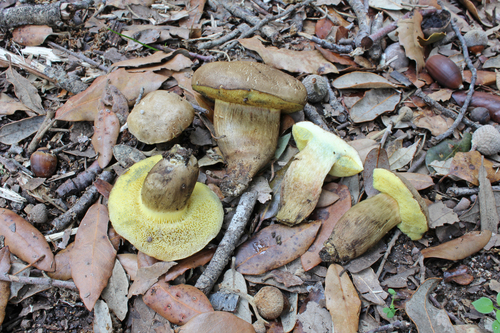
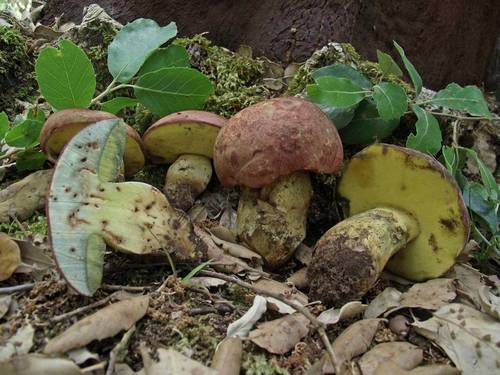
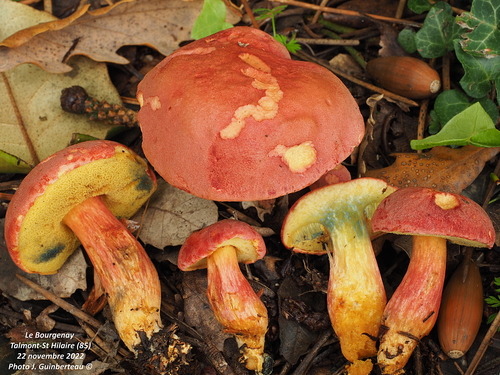
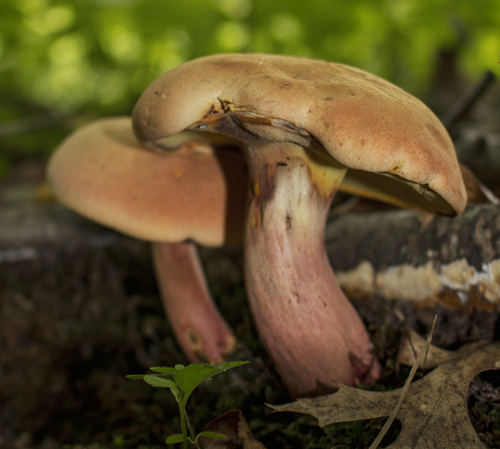
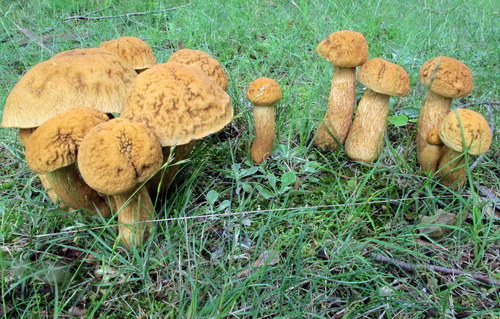
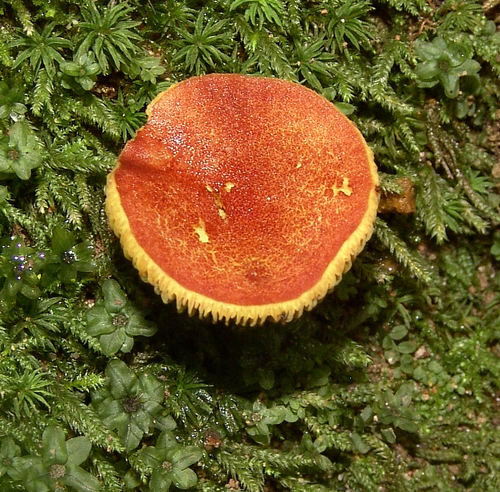
Rubroboletus eastwoodiae is a basidiomycete fungus in the bolete family, that is sometimes incorrectly referred to as satan's bolete. It is possibly toxic, and its edibility remains unknown, with potential for it to be poisonous. This fungus produces a convex cap that measures 6–25 centimetres (2+1⁄2–10 inches) across. Young caps have an inward-curving margin that expands as the fungus matures. The cap is dry, olive-colored, and takes on a pinkish tone as it ages. The cap flesh is yellowish. The stalk grows 7–15 centimetres (3–6 inches) tall and 3–6 centimetres (1+1⁄4–2+1⁄4 inches) wide. When cut, the flesh of the fungus turns blue. Its spores are elliptical, smooth, and olive-brown, and it produces an olive brown spore print. R. eastwoodiae is closely related to Rubroboletus pulcherrimus. It shares visual similarities with several related species: it looks like the European species R. satanas but is genetically distinct, and it also resembles both R. pulcherrimus and Suillellus amygdalinus. This fungus grows under oak trees along the West Coast of the United States, and it fruits from November to January.