About Rubiaceae
The Rubiaceae family is a morphologically coherent group that is easily recognizable by a combination of key traits: simple, entire leaves that are arranged oppositely or in whorls, interpetiolar stipules, tubular sympetalous actinomorphic corollas, and an inferior ovary.
This family includes a very wide range of growth forms. Shrubs are the most common, seen in genera such as Coffea and Psychotria, but members can also be trees like Cinchona and Nauclea, lianas like Psychotria samoritourei, or herbs like Galium and Spermacoce. Some epiphytes also occur, including Myrmecodia. Plants in this family usually contain iridoids and various alkaloids, and raphide crystals are common.
Almost all leaves are simple, undivided, and entire; the only known exception is Pentagonia osapinnata, which has pinnately compound leaves. Leaf blades are most often elliptical, with a cuneate base and an acute tip. Bacterial leaf nodules, visible as dark spots or lines on leaves, can be found in three genera: Pavetta, Psychotria, and Sericanthe. Phyllotaxy is usually decussate, rarely whorled such as in Fadogia, or rarely seemingly alternate when one leaf at each node is reduced, such as in Sabicea sthenula.
A characteristic feature of Rubiaceae is stipules that are mostly fused into an interpetiolar structure on each side of the stem between opposite leaves. The inner surface of these structures often bears glands called colleters, which produce mucilaginous compounds that protect young shoots. The whorled leaves of the herbaceous tribe Rubieae have classically been interpreted as a combination of true leaves plus interpetiolar leaf-like stipules.
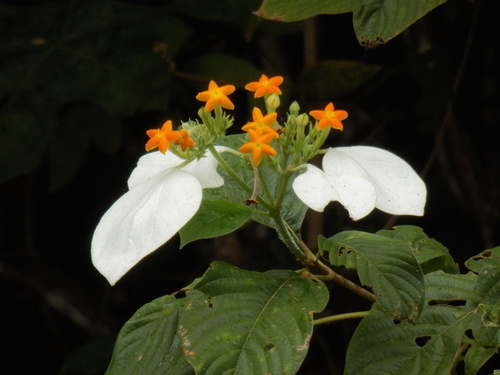
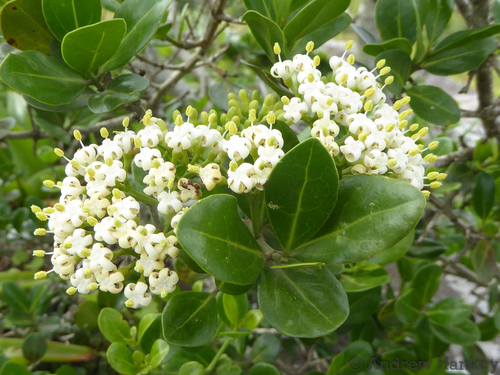
The inflorescence is typically a cyme, and it is rare for flowers to be solitary, such as in Rothmannia. Inflorescences are either terminal or axillary, and paired at the nodes. Flowers are most often 4-5-merous (rarely with more parts, for example six in Richardia), usually bisexual, and usually epigynous. The perianth is generally biseriate, though the calyx is absent in some taxa such as Theligonum. The calyx lobes are mostly fused at the base; unequal calyx lobes are not uncommon, and sometimes, such as in Mussaenda, one lobe becomes enlarged and coloured, forming a structure called a "semaphyl".
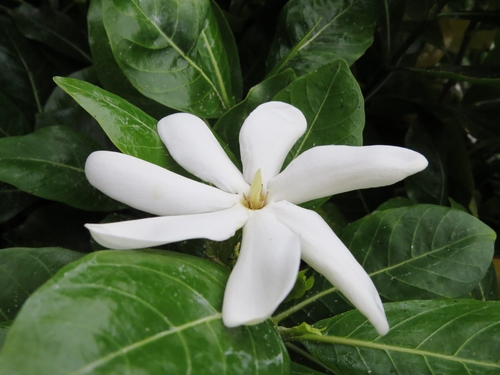
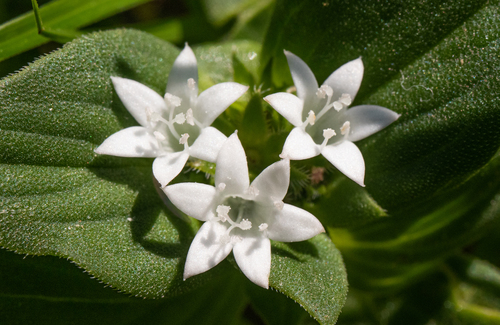
The corolla is sympetalous, mostly actinomorphic, and usually tubular. Corolla colour is most often white or creamy, but can also be yellow, as in Gardenia species and Mycelia basiflora, and rarely blue, as in Faramea calyptrata, or red, as in Alberta magna and Ixora coccinea. Stamens are alternipetalous and epipetalous. Anthers dehisce longitudinally in most cases, but dehiscence is poricidal in some genera such as Rustia and Tresanthera.
The gynoecium is syncarpous with an inferior ovary, which is very rarely secondarily superior, such as in Gaertnera and Pagamea. Placentation is axial, rarely parietal as in Gardenia. Ovules are anatropous to hemitropous, unitegmic, and have a funicular obturator, with one to many ovules per carpel. Nectaries are often present, forming a nectariferous disk atop the ovary.
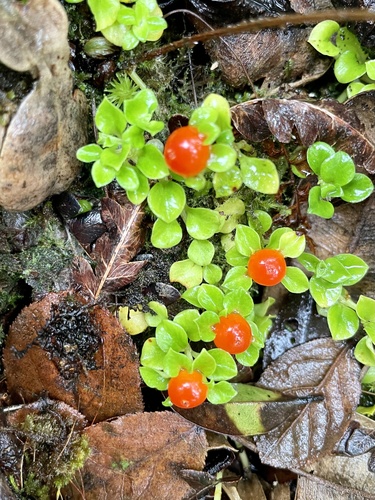
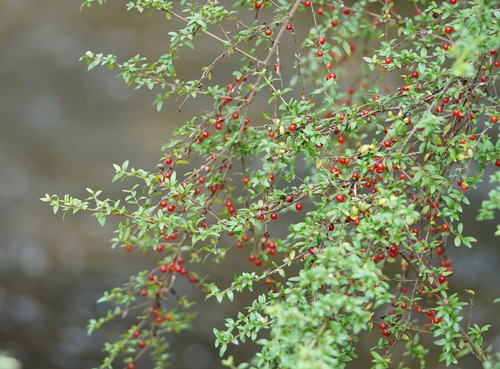
Fruits of Rubiaceae can take the form of berries, capsules such as in Oldenlandia, drupes such as in Coffea and Psychotria, or schizocarps such as in Cremocarpon. Red fruits are fairly dominant, for example in Coffea arabica; yellow (Rosenbergiodendron formosum), orange (Vangueria infausta), and blackish fruits (Pavetta gardeniifolia) are equally common, while blue fruits are quite exceptional, occurring only in Psychotrieae and related tribes. Most fruits are around 1 cm in diameter; very small fruits are relatively rare and found in herbaceous tribes, while very large fruits are rare and restricted to the Gardenieae. The seeds of Rubiaceae are endospermous.
Rubiaceae has a cosmopolitan distribution, found in nearly every region of the world except extreme environments like polar regions and deserts. Its overall distribution pattern is very similar to the global distribution of plant diversity as a whole. The highest diversity is distinctly concentrated in humid tropics and subtropics; the only exception is the tribe Rubieae, which is cosmopolitan but centered in temperate regions. Only a few genera are pantropical, such as Ixora and Psychotria; many genera are paleotropical, while Afro-American distributions are rare, such as in Sabicea. Endemic Rubiaceae genera occur in most tropical and subtropical floristic regions of the world. The highest number of species is found in Colombia, Venezuela, and New Guinea. When adjusted for area, Venezuela has the highest diversity, followed by Colombia and Cuba. Most members of Rubiaceae are terrestrial and predominantly woody. Woody Rubiaceae shrubs form an important part of the understorey of low- and mid-altitude rainforests. The family tolerates a broad range of environmental conditions including different soil types, altitudes, and community structures, and does not specialize on a single specific habitat type, though individual genera within the family often do.
There are no staple food crops in Rubiaceae, but some species are consumed locally, and their fruits may be used as famine food. Examples include African medlar fruits (V. infausta, V. madagascariensis), African peach (Nauclea latifolia), and noni (Morinda citrifolia).
Many Rubiaceae species have medicinal uses. The bark of Cinchona genus trees is the source of a variety of alkaloids, the best-known of which is quinine, one of the first effective treatments for malaria. Galium odoratum (woodruff), a small herbaceous perennial, contains coumarin, a natural precursor of warfarin. The South American species Carapichea ipecacuanha is the source of the emetic ipecac. Psychotria viridis is often used as a source of dimethyltryptamine to prepare ayahuasca, a psychoactive decoction. The bark of Breonadia salicina has been used in traditional African medicine for many years. The leaves of the kratom plant (Mitragyna speciosa) contain a variety of alkaloids including several psychoactive alkaloids. It is traditionally prepared and consumed in Southeast Asia, where it is known to have both painkilling and stimulant effects, acts as a μ-opioid receptor agonist, and is often used in traditional Thai medicine similarly to and as a replacement for opioid painkillers like morphine.