About Rubia tinctorum L.
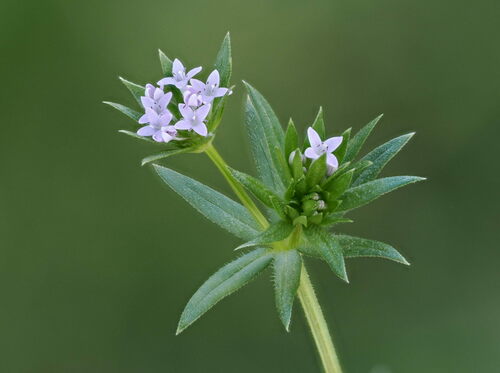
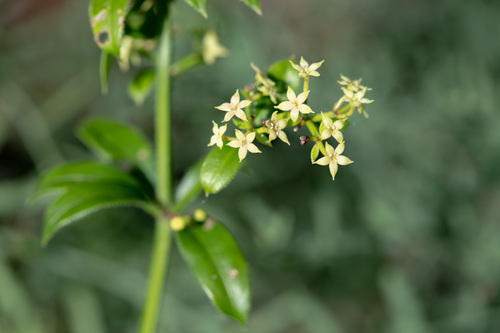
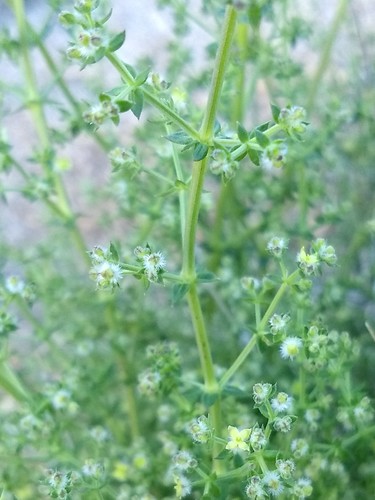
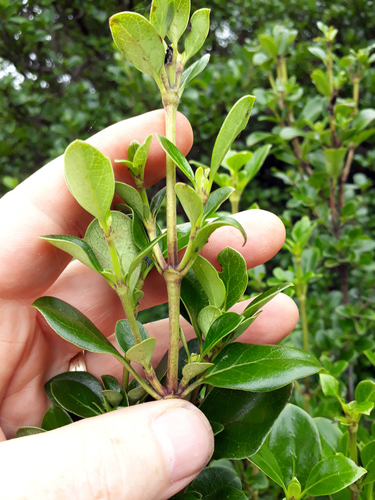
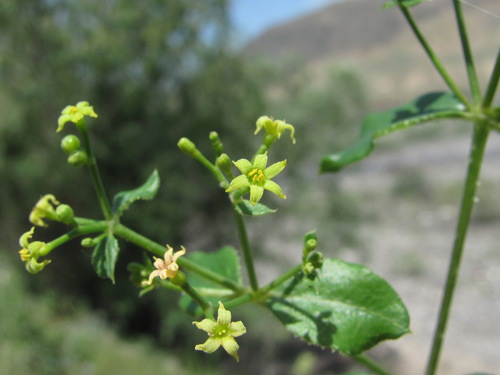
Rubia tinctorum L., commonly called common madder, can grow up to 1.5 meters in height. Its evergreen leaves are roughly 5 to 10 centimeters long and 2 to 3 centimeters broad, arranged in starlike whorls of 4 to 7 around the central stem. The plant climbs using tiny hooks present on its leaves and stems. Common madder produces small flowers 3 to 5 millimeters across, each with five pale yellow petals, that grow in dense racemes and bloom from June to August. After flowering, it forms small berries 4 to 6 millimeters in diameter that range in color from red to black. Its roots can grow over one meter long and up to 12 millimeters thick, and are the source of the red dyes rose madder and Turkey red. This plant prefers loamy soils (a mixture of sand and clay) with consistent moisture levels, as well as creek bed habitats. It serves as a food plant for the larvae of some Lepidoptera species, including the hummingbird hawk moth. Common madder has been used since ancient times as a natural vegetable red dye for leather, wool, cotton, and silk. To produce dye, roots are harvested after two years of growth. The outer red layer of the root yields the common variety of madder dye, while the inner yellow layer yields the refined variety. A mordant, most commonly alum, is used to fix the dye to cloth. Madder can also be fermented for dyeing to produce what is called Fleurs de garance. In France, leftover processing remains from madder were used to produce a spirit. Madder roots contain the acid ruberthyrin. Drying, fermenting, or treating the roots with acid converts ruberthyrin into sugar, alizarin, and purpurin; these compounds were first isolated by French chemist Pierre Jean Robiquet in 1826. Purpurin is normally uncolored, but turns red when dissolved in alkaline solutions. When mixed with clay and treated with alum and ammonia, purpurin produces a brilliant red colorant called madder lake. Pulverized madder roots can be dissolved in sulfuric acid, and drying after this process leaves a dye called garance, the French name for madder. To increase dye yield, roots that have already been used for dyeing can be dissolved in sulfuric acid, producing a dye called garanceux. Treating pulverized roots with alcohol produces a substance called colorine, which contains 40 to 50 times more alizarin than the original unprocessed roots. The red pigment from madder is alizarin, a member of the anthraquinone chemical group. In 1855, Professor Leonhardi of Dresden, Germany used alizarin to create alizarine ink. In 1869, German chemists Graebe and Liebermann synthesized artificial alizarin; industrial production of this synthetic version began in 1871, which effectively ended large-scale commercial cultivation of common madder. Through the 20th century, common madder was only grown in some areas of France. The plant's roots contain multiple polyphenolic compounds: 1,3-Dihydroxyanthraquinone (purpuroxanthin), 1,4-Dihydroxyanthraquinone (quinizarin), 1,2,4-Trihydroxyanthraquinone (purpurin), and 1,2-dihydroxyanthraquinone (alizarin). Alizarin is the compound that gives the red color to the textile dye known as rose madder. Alizarin from madder was also used as a colorant, especially for paint, in the product called madder lake. The same red substance can also be obtained from another plant species, Rubia cordifolia. Dyes derived from madder root have been used as textile dyes, lake pigments, food and cosmetic ingredients, and in medicine.