About Roystonea regia (Kunth) O.F.Cook
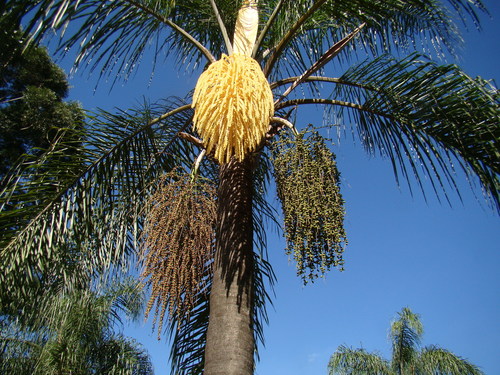
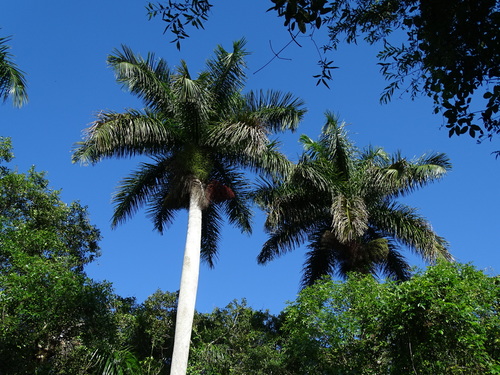
Roystonea regia (Kunth) O.F.Cook is a large palm that grows 20 to 30 metres (66 to 98 ft) tall, with maximum recorded heights reaching 34.5 m (113 ft). Its stem reaches about 47 centimetres (19 in) in diameter, and K. F. Connor recorded a maximum stem diameter of 61 cm (24 in). The stout trunk is very smooth and grey-white, with a characteristic bulge below a distinct green crownshaft. Each tree bears around 15 leaves, which can grow up to 4 m (13 ft) long. Its flowers are white with pinkish anthers. The fruit ranges from spheroid to ellipsoid in shape, measuring 8.9–15 millimetres (0.35–0.59 in) long and 7–10.9 mm (0.28–0.43 in) wide. Immature fruit are green, turning red and eventually purplish-black as they ripen. Root nodules containing Rhizobium bacteria have been found on R. regia trees in India. Root nodules containing rhizobia are typically associated with nitrogen fixation in legumes, and this finding marked the first recorded instance of root nodules in a monocotyledonous tree. Further evidence of nitrogen fixation was confirmed by the presence of nitrogenase, an enzyme required for nitrogen fixation, and leghaemoglobin, a compound that lets nitrogenase function by lowering the oxygen concentration in the root nodule. In addition to signs of nitrogen fixation, the nodules were also found to produce indole acetic acid, an important plant hormone. Roystonea regia is native to Central America, Cuba, the Cayman Islands, Hispaniola (including the Dominican Republic and Haiti), the Lesser Antilles, The Bahamas, southern Florida, and Mexico (specifically Veracruz, Campeche, Quintana Roo, and Yucatán). William Bartram described the species from Lake Dexter, along the St. Johns River in what is now Lake and Volusia Counties in central Florida, an area north of its current modern range, which suggests the species had a wider distribution in the past. It is most abundant in Cuba, where it grows on hillsides and in valleys. In southern Florida, it grows in strand swamps and hardwood hammocks. Royal Palm State Park in the Everglades was established because of the species' high concentration in the area. R. regia is cultivated as a landscape palm in tropical and subtropical climates across the United States, Australia, Brazil, and parts of southern Asia. It naturalizes easily, and extensive naturalized populations exist in Panama, Costa Rica, and Guyana. In the United States, it grows mostly in central and southern Florida, Hawaii, Puerto Rico, the Rio Grande Valley of South Texas, and southern California. Roystonea regia produces unisexual flowers that are pollinated by animals. European honey bees and bats are documented pollinators. Birds and bats that feed on the fruit disperse the plant's seeds. Seed germination follows the adjacent ligular pattern: as the cotyledon expands during germination, it only pushes a portion of the embryo out of the seed. As a result, the seedling develops next to the seed. The embryo forms a ligule, and the plumule emerges from this structure. Cultivated seedlings are reported to begin producing a stem two years after germination, when they grow their thirteenth leaf. In Florida, seedling growth averages 4.2 cm (1.7 in) per year. The leaves of R. regia are used as roosting sites by Eumops floridanus, the Florida bonneted bat, and act as a retreat for Cuban tree frogs (Osteopilus septentriolalis), a non-native species in Florida. In Panama, where R. regia is an introduced species, its trunks are used as nesting sites by yellow-crowned parrots (Amazona ochrocephala panamensis). Pollen-collecting bees visit the plant's flowers, which are considered a good source of nectar. Pollen from R. regia has also been found in the stomachs of Phyllonycteris poeyi (the Cuban flower bat, a pollen-feeder) and Monophyllus redmani (Leach's single leaf bat, a nectar-feeder). Artibeus jamaicensis (the Jamaican fruit bat) and Myiozetetes similis (the social flycatcher) feed on the plant's fruit. In Florida, R. regia is the host plant for the royal palm bug, Xylastodoris luteolus. It also serves as a larval host plant for the butterflies Pyrrhocalles antiqua orientis and Asbolis capucinus in Cuba, and for Brassolis astyra and B. sophorae in Brazil. The species is susceptible to bud rot caused by the oomycete Phytophthora palmivora and the fungus Thielaviopsis paradoxa. It is classified as an invasive species in secondary forest in Panama. Roystonea regia has been planted across the tropics and subtropics as an ornamental plant. Its seeds are used as a source of oil and as livestock feed. Leaves are used for thatching, and the wood is used for construction. The roots are used as a diuretic, and for this purpose Cubans of Haitian origin add them to tifey, a traditional Haitian drink. The roots are also used as a treatment for diabetes. Fibres extracted from the leaf sheath of R. regia have been found comparable to sisal and banana fibres, but have lower density, making them a potentially useful source for lightweight composite materials. An extract from R. regia fruit known as D-004 reduces benign prostate hyperplasia (BPH) in rodents. D-004, a mixture of fatty acids, is being studied as a potential alternative to finasteride for the treatment of BPH.