About Roystonea oleracea (Jacq.) O.F.Cook
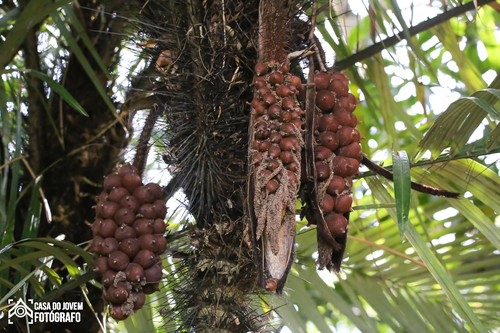
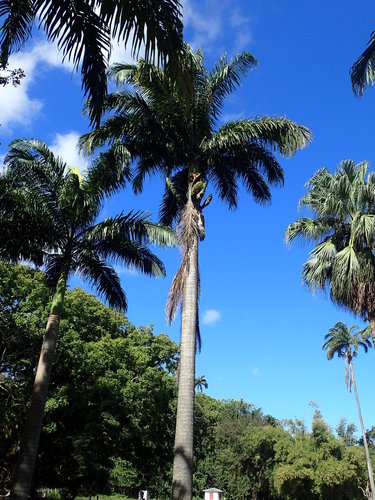
Roystonea oleracea is a large palm that grows to heights of 40 metres (130 ft). The tallest recorded standing specimen measures 38.7 metres (127 ft), not counting the crownshaft or fronds; longer measurements have been reported for felled specimens. Its stems are grey or whitish-grey, and range from 46 to 66 centimetres (18 to 26 in) in diameter. Leaf sheaths encircle the upper portion of the stem to form a green structure called the crownshaft, which is typically about 2 m (6.6 ft) long. Individual plants are recorded to have either 16–22 or 20–22 leaves. Leaves are once-pinnate, made up of a 60–100 cm (24–39 in) long petiole and a 4–4.6 m (13–15 ft) rachis. Leaflets attach to the rachis at various angles, giving the frond a bottlebrush-like look. The 1.4 m (4.6 ft) inflorescence holds white male and female flowers. Ripe fruit is 12.6–17.6 millimetres (0.50–0.69 in) long and 7.6–10.4 mm (0.30–0.41 in) wide, and turns purplish-black when mature.
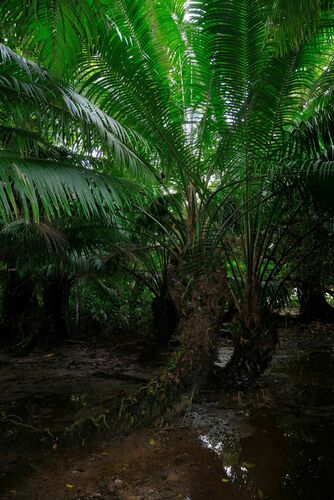
Roystonea oleracea is native to Guadeloupe, Dominica, Martinique in the Lesser Antilles, Barbados, Trinidad and Tobago, northern Venezuela, and northeastern Colombia. It is naturalized in Antigua, Guyana, Suriname, and French Guiana. It commonly grows in areas that are wet for at least part of the year, including coastal areas near the sea and gallery forests in seasonally flooded savannas.
In Nariva Swamp, Trinidad and Tobago, the fruit of Roystonea oleracea is an important part of the diet of orange-winged amazon parrots and red-bellied macaws. A study carried out between 1995 and 1996 found that R. oleracea fruit was an important dietary element for both species from June to January, and was their dominant food source from July to November.
Described as the tallest and most majestic royal palm, Roystonea oleracea is often planted as an ornamental tree. Its wood can be used for construction. The terminal bud is edible. Sap from young inflorescences can be fermented to make alcohol. In Griffith Hughes' 1750 Natural History of Barbados, he reported that immature inflorescences could be pickled and eaten as a vegetable.