About Roystonea borinquena O.F.Cook
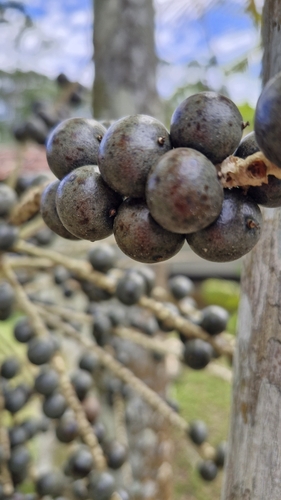
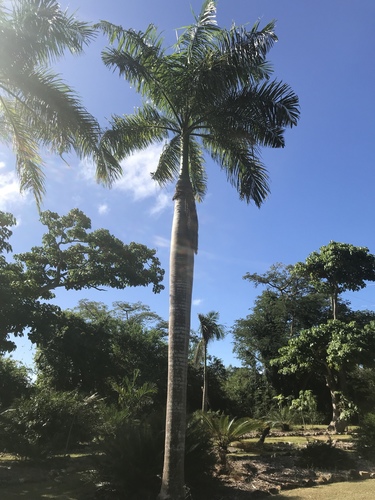
Roystonea borinquena is a large palm that typically grows 12 to 18 metres (40 to 60 ft) tall, though some individuals have been recorded reaching 26.4 m (87 ft) in height. Its stems are smooth, colored grey-brown to cinnamon-brown, and measure 25–70 centimetres (10–28 in) in diameter. Its leaves range from 2.4–3.7 m (7.9–12.1 ft) long, with short petioles and 1–3 m (3.3–9.8 ft) long leaf sheathes that encircle the upper stem to form a crownshaft. Its 1–1.4 m (3.3–4.6 ft) inflorescences hold creamy yellow male and female flowers, and the anthers of male flowers are bright purple. The fruit is single-seeded, about 13 millimetres (0.5 in) long and 10 mm (0.4 in) wide; immature fruit are greenish-yellow, and turn brownish-purple when ripe. Roystonea borinquena is native to Hispaniola, Puerto Rico including Vieques, and the Virgin Islands locations St. Croix, St. John, and Tortola. In Hispaniola, it occurs at elevations below 800 metres (2,600 ft) above sea level, and is absent from the driest regions. In Puerto Rico, it is found in areas below 300 m (1,000 ft) above sea level that receive 1,250–2,500 millimetres (49–98 in) of rainfall annually. Young Roystonea borinquena trees can start flowering when they are around seven years old, and they flower year-round. The flowers produce nectar, are visited by honey bees, and are thought to be pollinated by insects. On average, flowering trees grow 3.2 inflorescences per individual, and each inflorescence produces between 6 and 12,000 fruit. Seeds germinate 50–100 days after sowing. After six months, seedlings grown in full sunlight can reach 30 centimetres (12 in) in height, and young trees grow an average of 1 metre (3 ft 3 in) per year. The fruit of Roystonea borinquena is a fat-rich food source for birds. White-crowned pigeons (Patagioenas leucocephala) have been recorded dispersing the species' seeds. The Critically Endangered Ridgway's hawk (Buteo ridgwayi), which is endemic to Hispaniola, prefers to nest in Roystonea borinquena. Palmchats (Dulus dominicus), another endemic species of Hispaniola, also prefer this palm when building their large communal nests. Royal palms are popular ornamental plants for their striking appearance, and Roystonea borinquena is widely planted as an ornamental in Puerto Rico. Its tolerance of air pollution, ability to grow in many soil types, and roots that do not damage sidewalks make it especially useful for landscaping and street planting. Its timber is sometimes used for construction, but it is easily damaged by termites. Its leaves are used for thatch, and its leaf sheaths can be laid flat to make the sides of buildings. Historically, trunk bark has been used as clapboards called tablas (de palma) or planche (de yagua) for siding on bohío houses native to Hispaniola and Cuba. Its fruit is also used as feed for pigs and other livestock.