About Rosa woodsii Lindl.
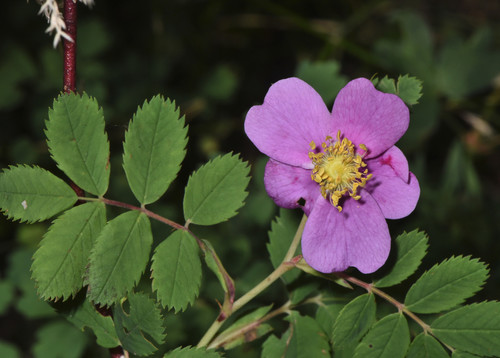
Rosa woodsii is a perennial bushy shrub that reaches up to 3 meters (10 feet) in height. These shrubs can grow into large, dense thickets. The species reproduces both sexually via seeds and vegetatively by sprouting from the root crown, layering, and producing root suckers. Its stems are straight, range in color from red to grey-brown, and are covered in prickles. The deciduous leaves are each composed of several widely spaced, sharp-toothed leaflets that grow up to 5 centimeters (2 inches) long. The inflorescence is a cyme holding up to a few fragrant flowers. Each flower has five petals that come in any shade of pink, and measures up to 2.5 cm across. Flowering occurs between May and July, and flowers bear many stamens and pistils. The fruit is a red rose hip that may grow over 1 cm long, and matures between August and September. The rose hips of this plant can be eaten, used to make tea, or used as medicine. This species is native to North America, where it occurs across much of Canada, Alaska, and the western and central United States. It grows in a wide range of habitats, including open woods, plains, stream banks, stony slopes, and disturbed areas. In the Sierra Nevada, it grows at elevations up to 3,400 m (11,200 ft) in moist, rocky soils within mixed coniferous forest, upper montane forest, and subalpine forest.