About Rosa rugosa Thunb.
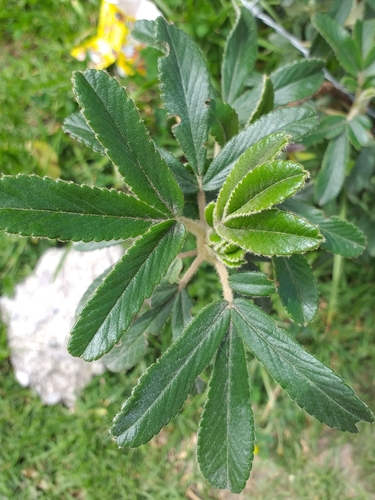
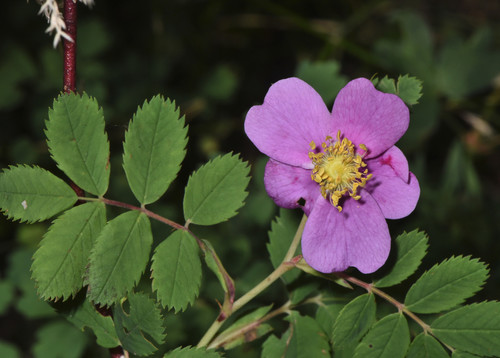
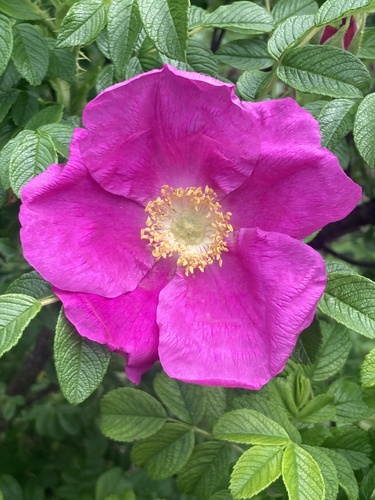
Rosa rugosa Thunb. is a suckering shrub that grows new plants from its roots and forms dense thickets 1 to 1.5 meters tall. Its stems are densely covered in many short, straight prickles that measure 3 to 10 millimeters long. The leaves are 8 to 15 centimeters long, and are pinnate with 5 to 9 leaflets—most commonly 7. Each leaflet is 3 to 4 centimeters long, with a distinctly corrugated, or rugose surface, which is how the species got its name. Leaflets are elliptical with a rounded or broadly cuneate base, have a leathery texture, and are dark green on the upper surface. The underside of the leaf is green-grey, with hairs growing along the veins. Leaf margins are crenate-serrate, with teeth along the edges. Flowers are typically 6 to 9 centimeters across, have five petals, and contain 200 to 250 stamens per flower with varying style lengths. They have a pleasant scent, and their color ranges from dark pink to white in the form R. rugosa f. alba (Ware) Rehder; petals are somewhat wrinkled, and flowering occurs in spring. The edible hips are large, 2 to 3 centimeters in diameter, resemble cherry tomatoes, and are often shorter than they are wide rather than elongated. In late summer and early autumn, plants often produce both fruit and flowers at the same time. Before falling in autumn, leaves typically turn bright yellow. Rosa rugosa is widely cultivated and used as an ornamental plant, and has been introduced to many areas of Europe and North America. It has many common names; several reference the fruit's resemblance to a tomato, including beach tomato and sea tomato, while others include saltspray rose and Turkestan rose. In parts of the United States, the fruits are occasionally called beach plums, which causes confusion with the true beach plum, Prunus maritima. In China, the sweetly scented flowers are traditionally used to make flower jam and desserts, and both China and Japan use the flowers to make pot-pourri. The species is also used in traditional Chinese medicine. Like hips from other rose species, the beach rose hips of Rosa rugosa are edible, and can be eaten raw or used to make jams, syrups, and tea. This species hybridizes easily with many other roses, and is valued by rose breeders for its high resistance to the diseases rose rust and rose black spot. It is also extremely tolerant of seaside salt spray and storms, and is commonly the first shrub found growing in from the coast. It is widely used in landscaping because it is relatively tough and trouble-free. Since it is very disease resistant, it requires little maintenance and is suitable for planting in large numbers; its salt tolerance makes it useful for planting beside roads that are regularly deiced with salt. It can also be used to control erosion. Many cultivars have been selected for garden use, with flower colors ranging from white to dark red-purple, and flower forms ranging from semi-double to double, where some or all stamens are replaced by extra petals. Popular cultivars include 'Rubra Plena', a semi-double variant with strongly clove-scented dark pink petals, dark green wrinkled leaves, and large round orange-red hips; 'Hansa', a fragrant red-purple double flowered cultivar; 'Fru Dagmar Hastrup', a single-flowered pink cultivar; 'Pink Grootendorst', a semi-double-flowered pink cultivar; 'Blanc Double de Coubert', a double-flowered white cultivar; and the more common 'Roseraie de L'Haÿ', a double-flowered pink cultivar often used for its excellent rootstock and ornamental rose hips.