About Rosa rubiginosa L.
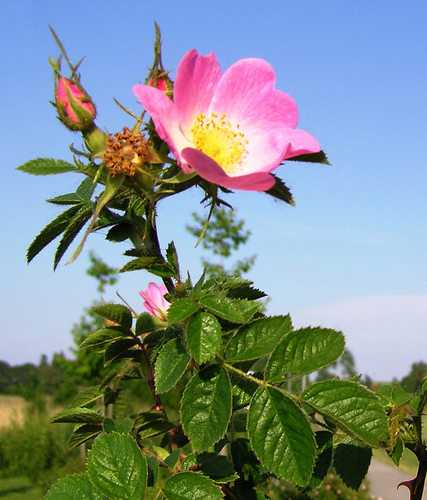
Rosa rubiginosa L. is a dense deciduous shrub that reaches 2–3 meters in both height and width. Its stems bear numerous hooked prickles. Its foliage has a strong apple-like fragrance. The leaves are pinnately compound, 5–9 cm long, and hold 5–9 rounded to oval leaflets. These leaflets have serrated margins and are covered in numerous glandular hairs. Flowers measure 1.8–3 cm in diameter; each has five pink petals with white bases, and many yellow stamens. Flowers grow in clusters of 2 to 7, and bloom from late spring to mid-summer. The fruit is a red hip, ranging from globose to oblong in shape, that measures 1–2 cm in diameter.
This species is native to most of Europe, excluding the extreme north above 61°N; its presence in western Asia is considered doubtful. It grows in pastures and thorny scrub from montane to subalpine elevations, in sunny, continental climates. It is somewhat rare, typically found as isolated specimens near roads and cattle-grazed pastures. In Southern Europe, it occurs at higher altitudes, usually between 1,000 and 1,700 m (3,300 to 5,600 ft). In Portugal, it is classified as Critically Endangered, and is restricted only to the Serra da Estrela range.
In cultivation, Rosa rubiginosa is valued for its pink flowers, its pleasant scent, and its hips, which form after flowering and persist through winter. During World War II, the British used rose hips and hops as assumed sources of vitamins A and C; this reliance gave rise to the British wartime saying: "We are getting by on our hips and hops."