About Rosa pisocarpa A.Gray
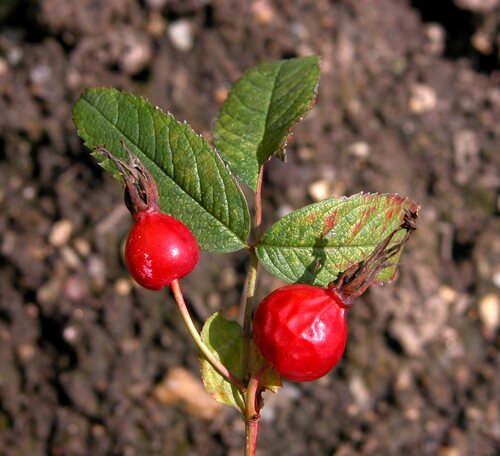
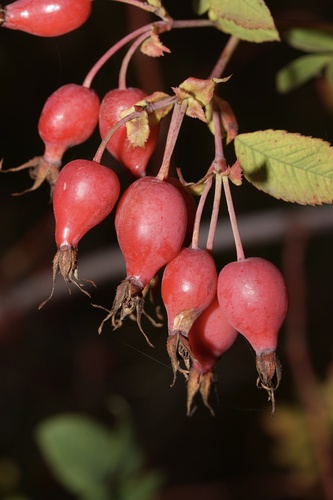
Rosa pisocarpa A.Gray is a rose species with the common names cluster rose and swamp rose. It is native to western North America, ranging from British Columbia to northern California, where it typically grows in moist habitats. This species is a shrub that sometimes forms thickets, and can grow up to 2.5 meters tall. Its stems may be dark red or blackish, and are often covered with straight, paired prickles at the nodes. Each leaf is composed of several toothed oval leaflets, and the terminal leaflet can reach up to 4 centimeters in length. The inflorescence is a cyme holding up to 10 flowers, each with pink petals up to 2 centimeters long. The fruit of this plant is a rose hip around a centimeter wide. These hips are pear-shaped or egg-shaped, grow in clusters, and are decorative in fall and early winter: at this time they turn red or reddish-purple, and contrast against yellow foliage. Fall foliage of this shrub can be yellow or dark red. Rosa pisocarpa has a wetland indicator status of FAC for the Pacific Northwest (region 9) and FACU for California (region 0). It grows in full sun in the northern, wetter sections of its range, but it also tolerates partial shade, and can grow in dry or lean soils. This rose grows in riparian areas, along roadside ditches, in powerline right-of-ways, along fencerows and hedgerows, and in wetland buffers and woodlands. It is used for wetland restoration projects and in native plant landscaping. Its thorny thickets and numerous persistent hips provide shelter and food for birds and other small wildlife. Deer browse the plant's new stems and foliage. Rosa pisocarpa acts as a host for gall-making wasps in the family Cynipidae, genus Diplolepis, of the class Hymenoptera. The two known wasp species hosted by this rose are D. polita, which forms bristly round red or green galls on leaves, and D. rosae (the mossy rose gall wasp), which forms large, mossy, feathery greenish or yellowish galls on stems.