About Rosa pendulina L.
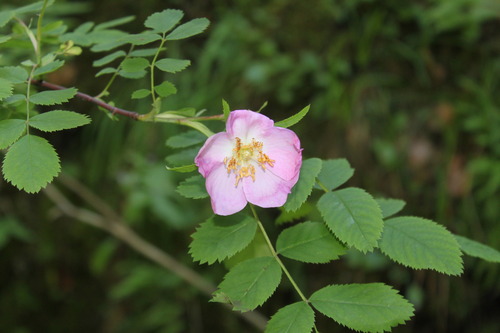
Rosa pendulina L. is a climbing or rambling shrub that grows between 0.5 and 2 meters tall, rarely reaching 3 meters. Its flowers are typically semi-doubled, colored deep pink to fuchsia, and lighten in shade toward the center. It can be told apart from other species in the Rosa genus by several key traits: it has relatively few thorns (prickles), especially on the upper sections of the plant; it produces oblong fruits (hips) that hang downwards (are pendulous, which gives the species its specific epithet); it has hispid peduncles and petioles; and it has smooth stems and branches. Its chromosome number is 4n = 28. This species prefers to grow in relatively warm, shady, moist locations. It grows alongside streams, in forest openings, or on rock piles, at elevations between 350 and 2,500 meters above sea level. It occurs mostly in the subalpine zone of mountains in Central and Southern Europe, including the Pyrenees, Massif Central, and Alps (reaching 2300–2600 m in different parts of its range). It is also found throughout the Carpathians (up to 1800 m in the Tatras), in Czechia and adjacent areas of Germany and Poland, in the Apennines, and in the mountains of the Balkan Peninsula (at 1000–2500 m in Bulgaria). It has been introduced to New England, and can be found growing as a garden escapee in other locations outside its native range. Often known by its synonym Rosa alpina (the Alpine rose), this species has been in cultivation for hundreds of years, since around 1683. Many of its cultivated varieties are practically forgotten today. It has contributed genetically to an unknown but large number of currently existing rose cultivars. It has several traits desirable to rose breeders: it flowers early, produces a pleasant strong fragrance, and is nearly thornless. One undesirable trait is its weak flower-supporting pedicels, which causes the mature fruits to hang in a pendulous habit. It is hardy to USDA Zone 4a.