About Rosa nutkana C.Presl
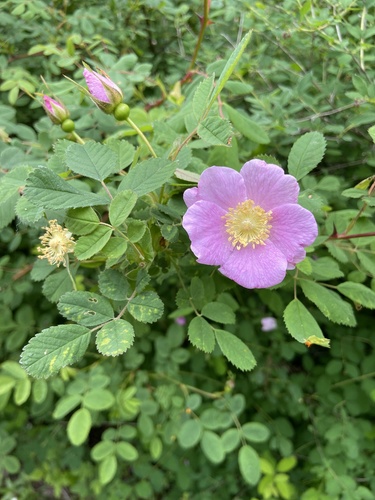
This species, commonly called Nootka rose, has the scientific name Rosa nutkana C.Presl. It can grow up to 3 meters tall, and often forms thickets. It produces light green paired leaflets with toothed edges, and sharp straight paired prickles that generally grow at nodes at the leaf base. Its flowers measure 5–8 cm (2–3 in) across, most often growing singly but occasionally appearing in groups of 2 or 3. Flowers emerge in early summer and can carry a pleasantly strong fragrance. The sepals are very long, longer than the petals, and are constricted in the middle. The edible rose hips of this species have a somewhat bitter taste; bletting the hips is reported to greatly reduce bitterness and improve palatability. Only the rind of the hip should be eaten, as the seeds are irritating to consume. Nootka rose grows across a wide range of habitats, from sea level to mid elevations. It requires full sun but can tolerate partial shade, and is commonly found growing along forest edges. It grows in both moist riparian soils and dry glacial till soils, and occurs in fencerows, hedgerows, pastures, shrubby wetlands, woodlands, prairies, and meadows. Thickets of Nootka rose provide habitat and food for birds and small wildlife; deer browse the species' flowers, young stems, and hips. This rose is used in wetland mitigation buffers and in native plant landscaping. Rosa nutkana acts as a host for gall-making wasps in the family Cynipidae, genus Diplolepis. Two of these wasp species are D. polita, which forms bristly round red or green galls on rose leaves, and D. rosae (the mossy rose gall wasp), which forms large, mossy, feathery greenish or yellowish galls on rose stems. Rosa nutkana is used by many indigenous peoples as a medicinal plant to treat a wide range of ailments, and is also used for ceremonies, handcrafts, and as a food source. Its branches or leaves were used to make tea or a poultice to treat sores and eye problems. Like all wild rose species, the hips of Nootka rose are edible and are sometimes used to make jams and jellies. It also serves as the larval host plant for mourning cloak and grey hairstreak butterflies. Nootka rose can be propagated from seed, though its germination rate is inconsistent. It can also be propagated from hardwood cuttings and root suckers. Several ornamental cultivars of R. nutkana exist: 'Cantab' (Hurst 1939), 'Mander's Nutkana #1' (1983), 'Moore's Nutkana', and 'Schoener's Nutkana' (1930).