About Rosa multiflora Thunb.
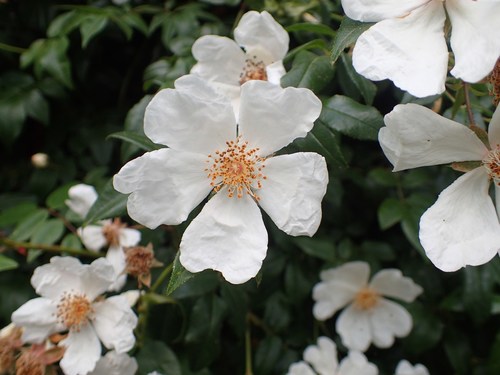
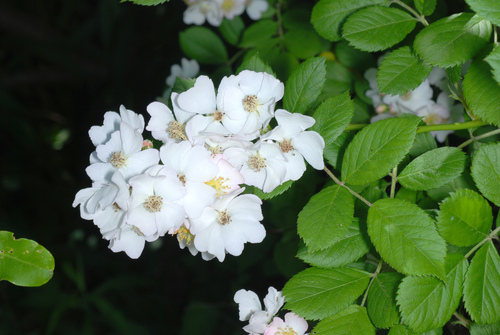
Rosa multiflora Thunb. is a scrambling shrub that can climb over other plants, reaching heights of 3 to 5 meters (9 feet 10 inches to 16 feet 5 inches). It has stout stems covered with recurved prickles, although prickles are sometimes absent. Its leaves are 5 to 10 centimeters (2 to 4 inches) long, compound, and have 5 to 9 leaflets and feathered stipules. Flowers grow in large corymbs; each small flower measures 1.5 to 4 centimeters (5⁄8 to 1+5⁄8 inches) in diameter, is white or pink, and blooms in early summer. The plant’s hips range in color from reddish to purple, and are 6 to 8 millimeters (15⁄64 to 5⁄16 inches) in diameter. Three varieties of Rosa multiflora are currently recognized: Rosa multiflora var. adenochaeta (Koidz.) Ohwi, Rosa multiflora var. cathayensis Rehder & E.H.Wilson, and the type variety Rosa multiflora var. multiflora; the two non-type varieties have many published synonyms. Rosa multiflora is cultivated as an ornamental plant, and also used as rootstock for grafted ornamental rose cultivars. In eastern North America, it is considered an invasive species. It was originally introduced from Asia for use as a soil conservation measure, as a natural hedge to border grazing land, and to attract wildlife. In some regions, the plant is classified as a noxious weed. In grazing areas, it is generally considered a serious pest, although it is excellent fodder for goats. The achene fruits (hips) of Rosa multiflora, called "Eijitsu" or "Rosae fructus", have been used to make tea, and have been used historically in traditional medicine and in modern clinical practice to treat constipation.