About Rosa gallica L.
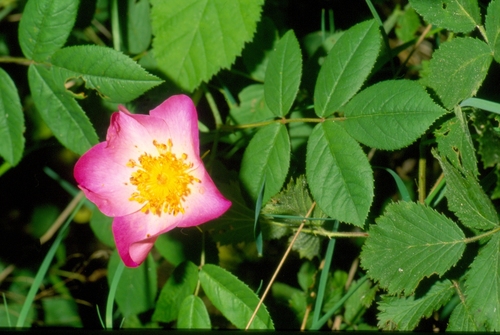
Rosa gallica L. is a deciduous shrub that grows into large patches. This species has slender, straight prickles that vary in size and frequency. Its leaves are pinnately compound, with three to seven bluish-green leaflets. Flowers grow in clusters of one to four, borne on glandular pedicels. Each flower has five or more petals, and may form double corollas. The blooms are fragrant and deep pink in color. The fruit (hips) are globose to ovoid, 10–13 mm in diameter, and range in color from orange to brownish. In food science research, rose petal extract from Rosa gallica has been found to have properties that reduce inflammation and wrinkling in human skin. This rose species was cultivated by the ancient Greeks and Romans, and was commonly grown in medieval gardens. Until the 19th century, it was the most commercially important cultivated rose species, and most modern European rose cultivars have at least a small genetic contribution from R. gallica in their ancestry. Rosa gallica is easy to cultivate in well-drained soil, in locations ranging from full sun to partial shade. It can survive temperatures as low as −25 °C. The following cultivars and hybrids of Rosa gallica currently hold the Royal Horticultural Society's Award of Garden Merit: 'Beau Narcisse' (Mielles, pre-1824), 'Charles de Mills' (pre-1790), 'Duc de Guiche' (pre-1810), 'Duchesse de Montebello' (Laffay, 1824), 'Président de Sèze' var. officinalis (sometimes listed as cultivar 'Officinalis' rather than a variety), 'Versicolor' ('Rosa mundi'), and 'Tuscany Superb'. Other notable cultivars include 'Cardinal de Richelieu' (Parmentier, pre-1847; withdrawn) – this rose was used as a starting material for genetic engineering to create the first blue rose – and 'Complicata'.