About Rosa dumalis Bechst.
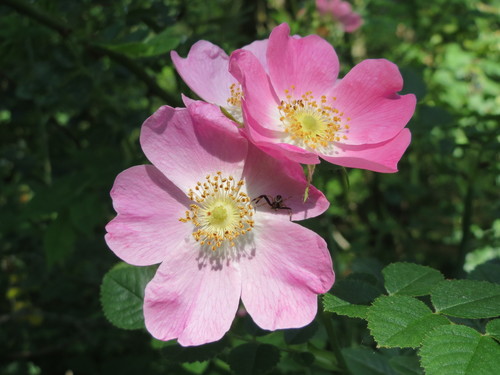
In the wild, Rosa dumalis Bechst. is a deciduous scrambling shrub that spreads via suckers. It reaches 1–2 meters (3 ft 3 in to 6 ft 7 in) in height, and has long, bent thorns. It produces fragrant, either dark or light pink flowers in June and July. Its oval hips ripen in autumn, are quite soft, and are rich in ascorbic acid, also known as vitamin C. Each fruit contains an average of 15.5 seeds. Fruits of this species are 66.2% water on average; by dry weight, fruits contain 14.4% carbohydrates and 0.5% lipids.
This species is native to a wide range of locations across Europe, North Africa, and Western Asia. In Europe, its native range includes Albania, Austria, Bosnia and Herzegovina, Bulgaria, Czech Republic, Denmark, Estonia, Finland, France, Germany, Great Britain, Greece, Hungary, Iceland, Ireland, Italy, Latvia, Lithuania, Moldova, Montenegro, Netherlands, North Macedonia, Norway, Poland, Portugal, Romania, Serbia, Spain, Slovakia, Slovenia, Sweden, Switzerland, Turkey, Ukraine, and Yugoslavia. It is also native to parts of the former Soviet region: Belarus, European Russia, and the North Caucasus area. In Africa, it is native to Algeria, Morocco, and Tunisia.
For several decades, the rose hips of Rosa canina and Rosa dumalis have been collected and traditionally used in Turkey. Collection mainly occurs during the winter months, after which the hips can be processed into multiple products including marmalade, syrup, jam, healthy tea, and jellies. Both species have long been known as medicinal plants and used in folk medicine, where rose hips are used to treat coughs, stomach aches, and sore throats. In Turkey, the plant's thorns and scrambling growth habit make it commonly used as a living fence or hedge in open areas, particularly along the edges of arable fields.