About Rosa carolina L.
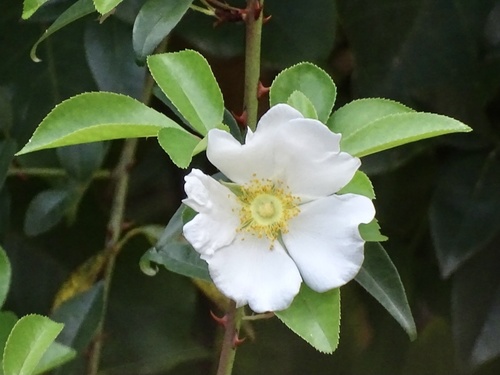
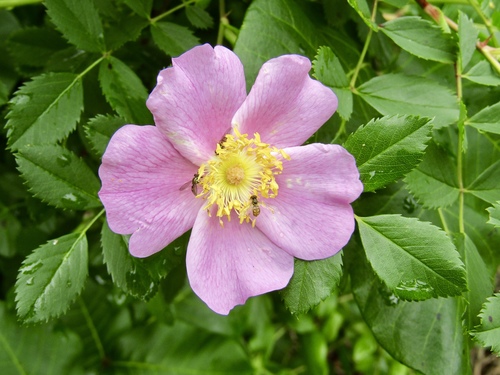
Rosa carolina L., commonly known as Carolina rose, is a perennial shrub. It can be distinguished from very similar species like R. palustris and R. virginiana by its straight, needle-like thorns; these related species have curved thorns. It can also be told apart from other wild rose species by its larger pink flowers, which bloom later than the flowers of many other wild rose species, bloom for a shorter period, and produce a shrub that tends to stay lower in height than other wild rose species. Its fragrant flowers open in early summer, do not repeat bloom, and typically grow singly at the ends of the current year's growth. Blooms measure around 6 to 8 centimeters (2.5 to 3 inches) in diameter, with five light pink petals and a yellow center. The shrub has upright stems: new growth stems are grayish, while larger, older branches are brown. Its foliage is smooth and dark green. Rosa carolina propagates via root spread, and new growth eventually forms small to large thickets. Mature thickets reach 0.5 to 1 m (18 to 40 inches) in height. The rosehips of this species are round, large, and have protrusions on the end opposite the stem. For comparison, Rosa setigera has small round hips similar to those of Rosa multiflora, grows much larger, and usually bears a mix of pink and white flowers. Rosa multiflora only produces white flowers. The invasive dog rose has pink flowers similar to those of R. setigera, but its hips are large and more cylindrical. Carolina rose is frequently found in a wide variety of habitats. It grows in dry soils at prairie, woodland, and savanna borders, within thickets, in upland forested areas, and on dunes. It also grows in wet soils along stream beds, in swamps, and in low grassy areas. Its native range extends from Nova Scotia, Canada, south to Florida, west to Texas, and north to Ontario. This species can be cultivated. To thrive, it requires full sun to moderate shade, well-drained soil, and regular watering. Its rose hips are edible, though they have a very tart flavor. The plant attracts multiple bee species and provides nesting materials for them.