About Rosa blanda Aiton
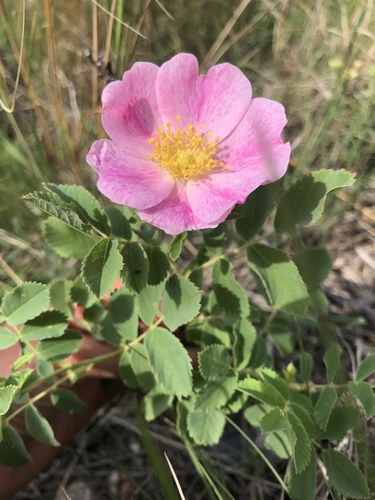
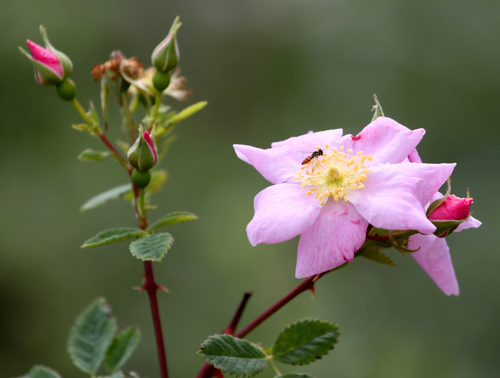
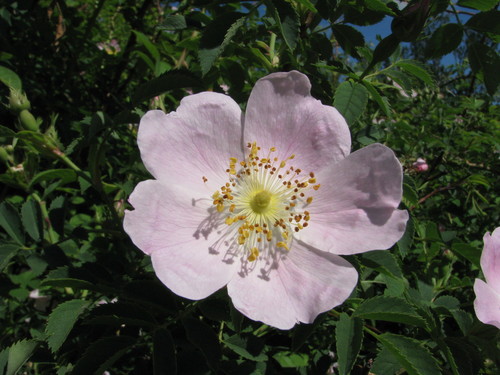
Rosa blanda Aiton produces perfect flowers that contain both stamens and carpels, and range in color from white to pink. Its species name derives from the Latin word blandus, which means "flattering, caressing, alluring, tempting", a reference to the beauty of its flowers. The species blooms in early summer; its flowers grow either singly or in corymbs from lateral buds. The central flower in each cluster opens first, it lacks a bract, and has a pedicel 2–4 cm (0.79–1.57 in) long, which is shorter and stouter than the pedicels of other prairie rose species. Each flower has five large petals, which are shaped either obovate or obcordate, measuring 3 cm (1.2 in) long and 2.5 cm (0.98 in) wide. Petals are white to pink with red streaks; anthers are yellow, stigma is yellow or orange, and filaments are white. After the petals fall, the stamens and style become erect. In the wild, Rosa blanda grows in meadows, prairies, and fields, as well as on dry hillsides, roadsides, and fence rows, thriving in either sandy or rocky soil. Its natural range extends from Quebec to Ontario, south to Kansas, and east to Missouri and Ohio. Rosa blanda is a sturdy perennial rose that can tolerate dry, nutrient-poor habitats such as roadsides and sandy soil. It is the native flower of regions in Kansas and North Dakota. This species is very similar in appearance to Rosa multiflora, an invasive species introduced from Japan. The two species can successfully grow alongside one another, providing benefits to the environment and animals. Hybridization between Rosa blanda and the Japanese rose Rosa rugosa has been recorded in eastern North America. This hybridization is a cause for concern, as it may lead to the development of vigorous hybrids with invasive potential, and cause genetic assimilation of the native Rosa blanda.