About Rosa banksiae R.Br. ex Aiton
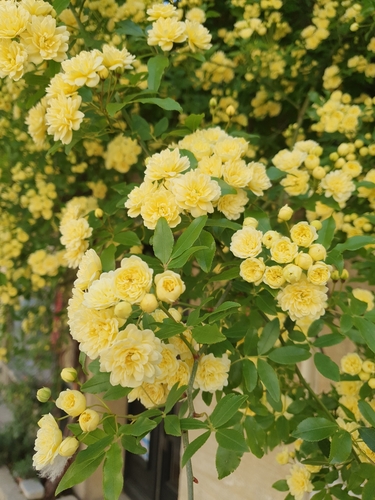
Rosa banksiae R.Br. ex Aiton, commonly called Lady Banks' rose, is a vigorous scrambling shrubby vine that grows up to 6 m (20 ft) tall. Unlike most rose species, it is practically thornless, though it may develop small prickles up to 5 mm long, especially on thick, sturdy shoots. Its leaves are evergreen, measure 4–6 cm in total length, and hold three to five (rarely seven) leaflets. Each leaflet is 2–5 cm long with a serrated margin. The species produces small flowers 1.5–2.5 cm in diameter, which are white or pale yellow, and fragrant. It is one of the earliest flowering rose species, typically blooming during May in the northern hemisphere, though cold temperatures can delay flowering. All Lady Banks' roses are reported to carry a violet-like scent, with intensity varying between individual plants. This species has likely been cultivated in Chinese gardens for hundreds of years. It was first introduced to Europe by William Kerr, who was sent on a plant-hunting expedition by Sir Joseph Banks. Kerr purchased the first introduced Lady Banks' rose, the white-flowered variety R. banksiae var. banksiae, from the well-known Fa Tee nursery in 1807. Several other forms of the species were later found growing in China, including R. banksiae var. normalis and R. banksiae 'Lutea', the yellow Lady Banks' rose, which was brought to Europe in 1824 by J. D. Parks. The 'Lutea' cultivar was awarded the Royal Horticultural Society's Award of Garden Merit in 1993. In traditional Chinese medicine, it is combined with other plants and herbs including monkshood and Ligusticum wallichii to create a liniment used to treat painful joint swelling. A specimen of R. banksiae planted in Tombstone, Arizona in 1885 is reputed to be the world's largest rose bush. It covers up to 9,000 square feet (840 m2) of an inn's roof, and has a trunk with a 12-foot (3.7 m) circumference.