About Rorippa palustris (L.) Besser
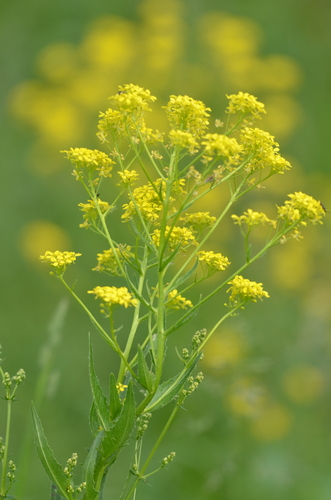
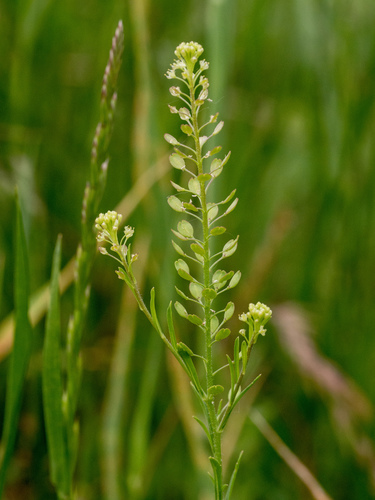
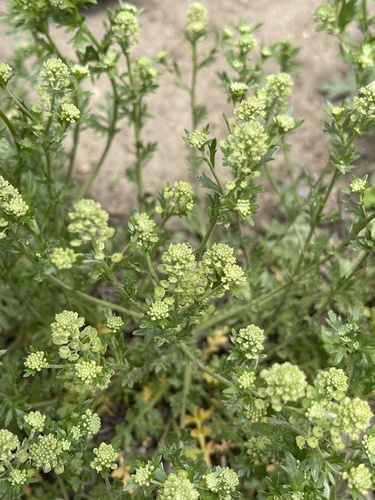
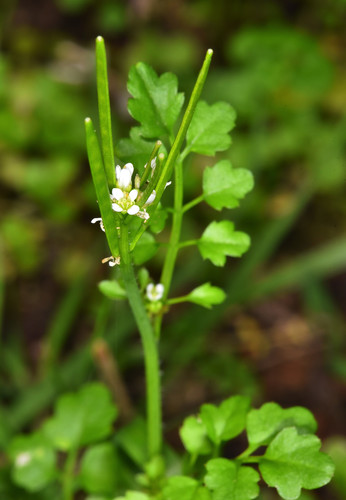
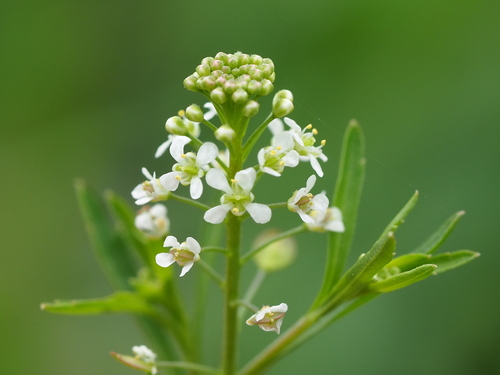
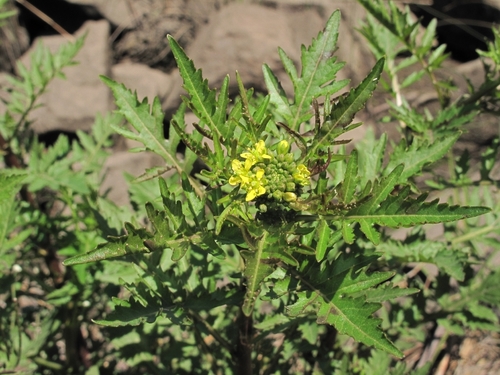
Rorippa palustris (L.) Besser produces an erect stem, sometimes branched, that reaches a maximum height of just over one meter. Its leaves grow up to 30 centimeters long, with edges ranging from toothed to deeply lobed. The inflorescence is a raceme of mustard-like flowers, each with spoon-shaped yellow petals a few millimeters in length. The fruit is a dehiscent, smooth-valved silicle that grows up to one centimeter long, and holds between 20 and 90 very small seeds. Rorippa palustris is native or naturalized across much of the world. Its native range spans multiple regions: In Africa, it is native to Egypt and Ethiopia. In Asia and Eurasia, it is native to Afghanistan, Bhutan, the Caucasus (Armenia, Azerbaijan, Georgia, Russia), Ciscaucasia (Dagestan), most of China and Taiwan, India (Assam, Bihar, Himachal Pradesh, Jammu and Kashmir, West Bengal), Indonesia (Papua province, Java, the Lesser Sunda Islands, Maluku Islands), Japan (Hokkaido, Honshu, Kyushu, Shikoku, Ryukyu Islands), Kazakhstan, the Korean Peninsula, Kyrgyzstan, Mongolia, Pakistan, Papua New Guinea, eastern and western Siberia, Tajikistan, northeastern Turkey, Turkmenistan, Uzbekistan, and Yemen. It is native to most regions of Europe. In North America, it is native to every Canadian province and territory except Nunavut, Puerto Rico, the District of Columbia, every U.S. state except Hawaii, and Mexico. In the Caribbean, it is native to Cuba and Haiti. It is native to New Zealand in Australasia. Its naturalized range includes Australia and New Zealand in Australasia, and Argentina, Brazil, Chile, Ecuador, Panama, Peru, and Suriname in Mesoamerica and South America.