About Roridomyces austrororidus (Singer) Rexer
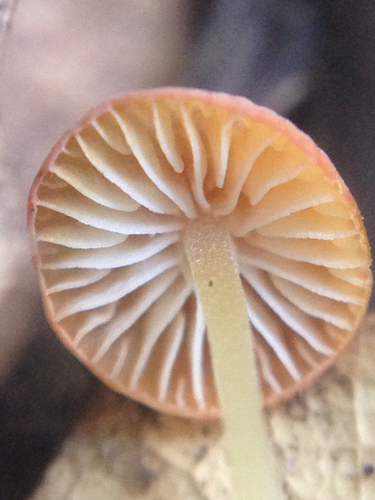
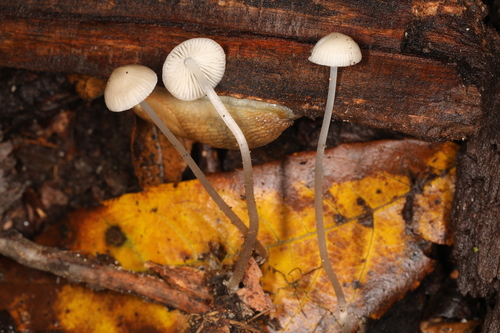
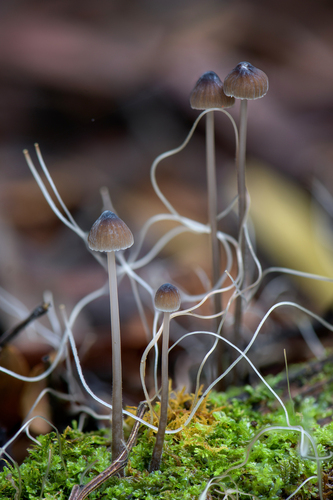
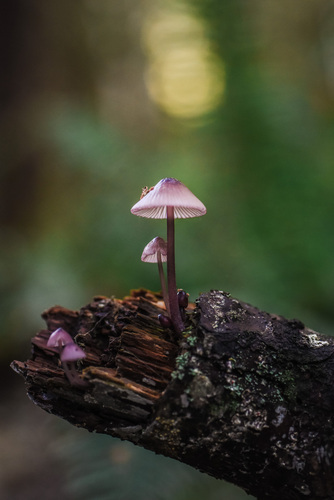
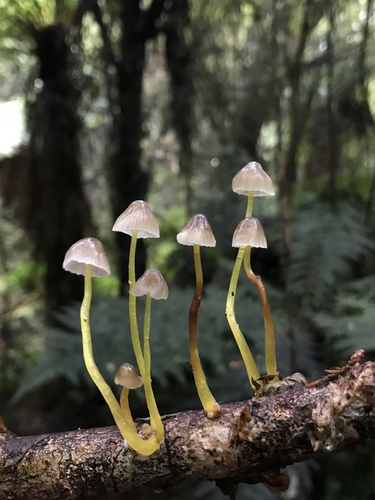
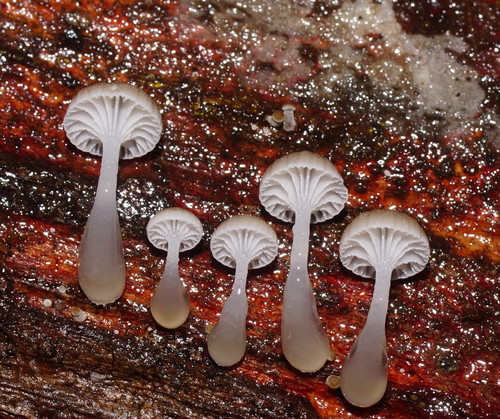
The cap of Roridomyces austrororidus ranges from shallowly convex to convex, or is irregularly convex. It may or may not have a shallow umbo, and measures up to 16 mm (0.63 in) in diameter and up to 5 mm (0.2 in) high. The cap margin curves downward, is sometimes slightly flared, and may have translucent radial striations that mark the positions of the gills underneath. The white flesh is thickest at the center of the cap, and tapers gradually toward the margin. The gills are broadly adnate (fused to the stipe) to decurrent (running down the length of the stipe). Gill edges are either smooth and even, or may have minute teeth. The gills are well-spaced, with 16 to 24 gills extending fully from the cap margin to the stipe, and two or three tiers of interspersed lamellulae, which are short gills that do not extend fully from the cap margin to the stipe. The stipe is smooth and cylindrical, up to 27 mm (1.1 in) long, and up to 2.5 mm (0.1 in) in diameter at the base, narrowing toward the top. It is hollow, has a texture ranging from silky to shiny, and is mucilaginous, usually with thick slime at the base. Short white hairs sometimes grow at the bottom of the stipe, though their presence is variable. This mushroom has no distinctive odor. Spores of Roridomyces austrororidus are roughly ellipsoidal, with a length/width Q ratio of 1.6, and dimensions of 9.4–15.4 by 6.2–9.0 μm. They have a small, oblique apiculus, lack oil droplets, are smooth with thin walls, and are hyaline (translucent). The spores are acyanophilous and strongly amyloid, meaning they do not stain with Methyl blue and do stain with Melzer's reagent, respectively. The spore-bearing basidia are four-spored, rarely two-spored, and club-shaped, with long, robust sterigmata up to 6.0 μm long. They have clamp connections at their bases, and measure 35.3–49.6 by 10.3–14.4 μm. Roridomyces austrororidus has two types of cheilocystidia, which are cystidia located on gill edges. One type is rare, broadly club-shaped, and tapers to a narrow stem, measuring 24.1–39.5 by 6.8–12.7 μm. The other type of cheilocystidia is moderately dense to abundant, and forms a sterile gill edge. They are cylindrical, measuring 27.5–70.4 by 5.4–10.4 μm, and often have a swollen tip that splits into two, rarely three branches. Like all members of its genus, Roridomyces austrororidus grows as a saprophyte on rotting wood. In Australia, this fungus fruits in clusters or groups on rainforest trees, decayed logs, fallen Eucalyptus branches, Bedfordia salicina logs and branches, and Nothofagus cunninghamii logs. Fruiting usually occurs after rainy periods from April to June, though the mushroom has also been collected in August. Collected specimens from New Zealand have been reported growing on Pinus, Leptospermum, and Ripogonum. A study of fungal succession in a wet eucalypt forest in Tasmania showed that R. austrororidus prefers mature forests (with at least 70 years of growth since the last wildfire), and fruits on small diameter wood, typically twigs with a width less than 15 mm (0.6 in). Roridomyces austrororidus occurs in Argentina, Chile, New Zealand, and Australia. Within Australia, its distribution includes Queensland, New South Wales, Victoria, Tasmania and Western Australia. Australian mycologist Tony Young suggests that the geographical distribution of the fungus indicates its ancestor may have originated from the ancient continent Gondwana.