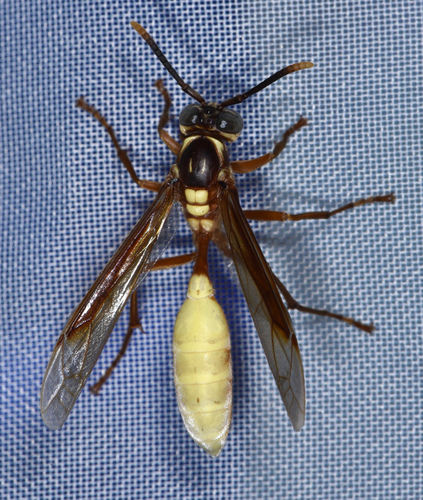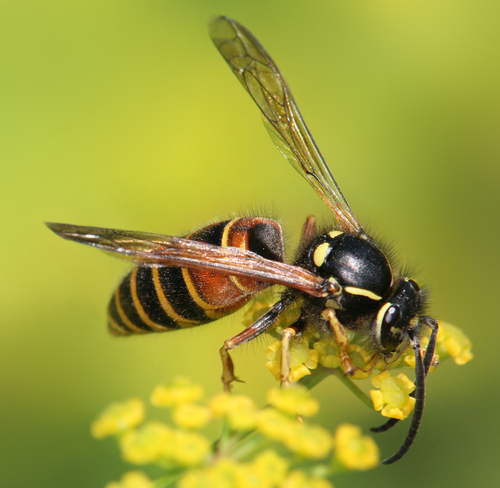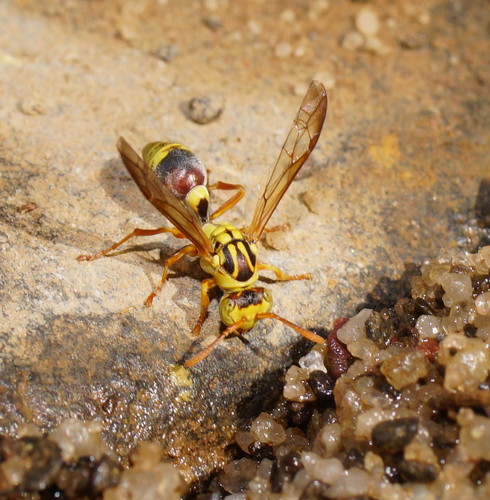
About Ropalidia romandi (Guill., 1841)
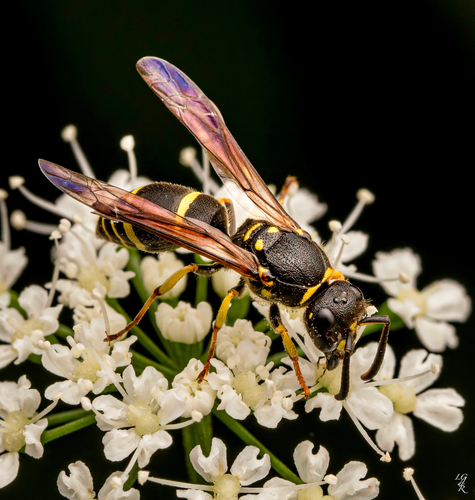
Ropalidia romandi (Guill., 1841) is set apart by its entirely yellow body, marked with dark brown patterns on the thorax and abdomen. This is a small paper wasp species, reaching approximately 12 millimeters in length. Like other Ropalidia wasps, the first abdominal segment of R. romandi is narrower than all segments that come after it. When at rest, this species folds its front wings lengthwise, a trait shared by most paper wasps. R. romandi constructs what is called a "paper bag nest", which has a papery outer envelope that covers multiple horizontal combs. Both the envelope and the combs inside are made from papery plant fibers bound together with the wasp's saliva. Nests are either spherical or hemispherical, can grow up to one meter in length, and are most often located on tree branches or the eaves of buildings. Queens and workers of R. romandi show morphological differences in size and body shape, but these differences vary across colonies and can sometimes be very faint. When worker-queen dimorphism does occur, the clearest difference is in the metasoma: queens have larger overall metasoma, plus a longer, more reddish second metasomal segment. The most distinct difference between queens and workers lies in the developmental state of their ovaries. In queens, all ovarioles contain mature or semi-mature oocytes, and oocytes develop sequentially inside the ovary. By contrast, workers have filamentous ovarioles, or ovarioles that only contain partially developed oocytes. Some individuals have ovaries that fall between the typical queen and worker developmental stages; these are thought to be either workers that begin laying eggs during swarming events, or young uninseminated queens. In Australia, R. romandi is distributed across the Northern Territory and Queensland. It is counted among the most common paper wasp species in Eastern Queensland. This species inhabits both tropical and temperate climates. Even so, its habitats regularly experience cold winters, which leads to seasonal patterns of colony activity. Nests hang from the undersides of various tree branches and building eaves, positioned between 2.5 meters and 30 meters above ground. Wasps very often attach their nests to Eucalyptus trees, which shed their bark frequently. When bark is shed, nests fall to the ground and are abandoned by the colony, which then quickly constructs a new nest.