About Romulea sabulosa Schltr. ex Bég.
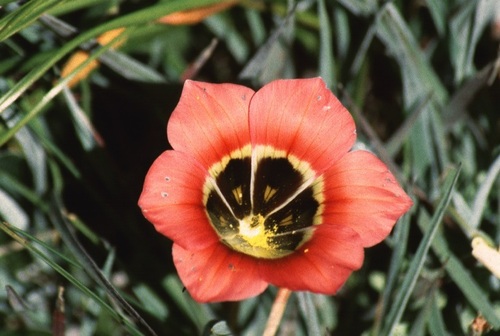
Romulea sabulosa is a low to medium-height perennial geophyte that grows 12–40 cm (4.7–15.7 in) tall. It has a subterranean stem that develops from a corm. The corm has a rounded base and is wrapped in a brown tunic with curved pointed teeth. Three to five thread-like leaves emerge directly from the soil; these leaves are about 1 mm (0.039 in) in diameter and have four grooves along their length. Over one growing season, each corm can produce one to four flowers. Each flower is subtended by two bracts with transparent, often brownish margins. The outer bract usually has one keel on its upper surface and a narrow transparent margin, while the inner bract has two keels and a wider papery margin. The scentless, trimerous flower is dark red, and sometimes pink, with black blotches inside a creamy green cup. The tepals are fused into a tube at their base and are inverted egg-shaped with a slightly indented tip, measuring 2½–4 cm (1–1.6 in) long. Outer tepals have light yellow feathered stripes. The stamens have free filaments 3–5 mm (0.12–0.20 in) long, topped by anthers 8–12 mm (0.31–0.47 in) long. The stalk supporting the ripe fruit stays more or less erect. Romulea sabulosa flowers from July to September. This species is restricted to the Bokkeveld plateau along the escarpment west of Nieuwoudtville, where it grows in large groups on light sandy clay called tillite. It has been observed that Romulea sabulosa is pollinated exclusively by monkey beetles.