About Romulea monadelpha (Sweet ex Steud.) Baker
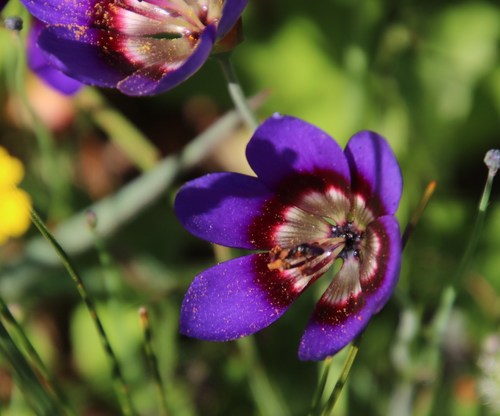
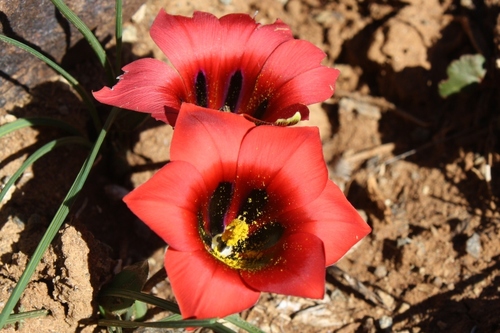
Romulea monadelpha is a low-growing geophyte that reaches 15–30 cm (5.9–11.8 in) in height. It grows from a corm with a rounded base covered by a tunic that bears curved acuminate teeth, and it has a subterranean stem. This species produces three to five thread-like leaves that emerge directly from the soil; these leaves are 1–2 mm (0.039–0.079 in) in diameter and have four grooves running along their length. Flowers grow singly at the end of a pedicel (flower stalk), and are subtended by two bracts, both of which mostly have brown papery margins. The outer bract usually has one keel on its upper side and a narrow papery margin, while the inner bract has two keels and a wider papery margin. The trimerous flowers are unscented, and are typically burgundy red with complexly patterned black and cream blotches inside the flower cup. An exception is the population around Gannaga Pass, where plants produce salmon-colored flowers with large black and light grey markings. The six oval tepals may be slightly indented at the tip, and measure 2½–4 cm (1–1.6 in) long. The three oblong-shaped filaments are tightly pressed together, or even fused, to form a 3–4 mm (0.12–0.16 in) long column. This column is mostly hairless, and is topped by anthers that are 1–1½ cm long. When the fruit is fully ripe, the flower stalk becomes curved. Flowers of this species bloom in August and September. Romulea monadelpha grows exclusively on dolerite clay in the western Karoo near escarpments. It is only known to be pollinated by the monkey beetle Clania glenlyonensis. This species is endemic to the Northern Cape province of South Africa. Its distribution runs along the Bokkeveld and Roggeveld escarpments, from near Nieuwoudtville southward to the top of Gannaga Pass near Middelpos in the south.