About Romulea columnae Sebast. & Mauri
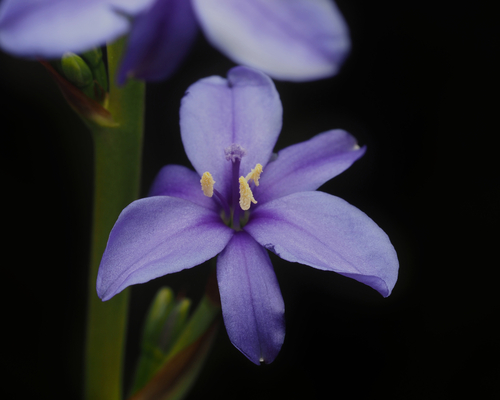
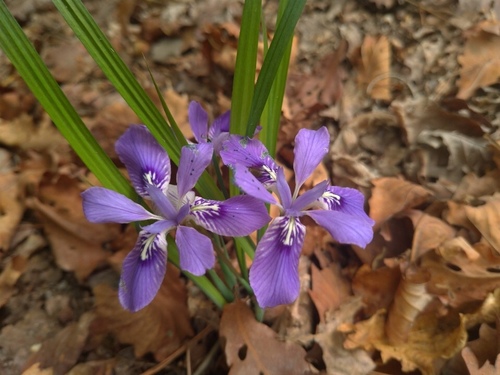
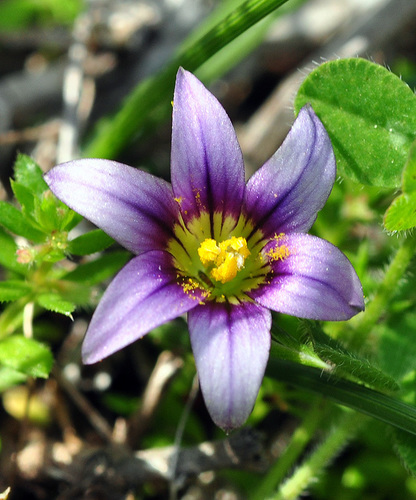
Romulea columnae grows from a small corm. It produces one or two basal leaves, plus up to 3 narrow, wiry, curled cauline (stem) leaves that can reach up to 10 cm (4 in) long. Plants in the Romulea genus are related to crocuses and look very similar, but have key differences: Romulea plants do not have a white groove in the center of their leaves. Additionally, crocus flowers are stemless and grow directly from the corm, while Romulea plants hold their flowers on a green scape of varying lengths. Romulea columnae has a short scape, reaching up to 3–20 cm (1–8 in) long; in the UK, specimens only grow 3–4 cm (1–2 in) tall. It blooms early in the year, starting from February, or between March and May. Each corm produces one to three flowers, with a single solitary flower being the most common. The small flowers measure 10 to 12 mm across, are funnel-shaped, and have 6 equal-sized petals that are pointed at the tip. Petals are pink, pale purple, or violet, with greenish-yellow, yellow, or golden-yellow coloring at the flower center or throat. They have purple or violet veins, or a dark midvein paired with two lighter lateral veins. It has a thin, spindly green spathe, three stamens topped with yellow or bright yellow anthers, and a style shorter than the stamens. It reproduces mostly by seed. Romulea columnae is native to temperate regions of western Asia, Africa, and Europe. In Africa, it occurs in Macaronesia (Madeira Islands and the Canary Islands), Algeria, Morocco, and Tunisia. In Asia, it is found in Cyprus, Israel, Lebanon, Syria, and western Turkey. In Europe, it grows in south west England, Greece (including Crete), Italy (including Sardinia and Sicily), France (including Corsica), Spain (including the Balearic Islands), and Portugal. It has become naturalized in the Azores. This species grows on free-draining sandy soils in coastal cliff slopes and coastal grasslands. It can also grow on sandy ground near the sea, including on golf courses such as the Dawlish Warren course in Devon, which is classified as a Site of Special Scientific Interest (SSSI). For cultivation in temperate gardens, this plant grows best inside a temperature-controlled Alpine house. It can be grown in containers filled with well-drained, loam-based compost. After flowers fade and leaves turn yellow in summer, the plant should be allowed to dry out.