About Rollulus rouloul (Scopoli, 1786)
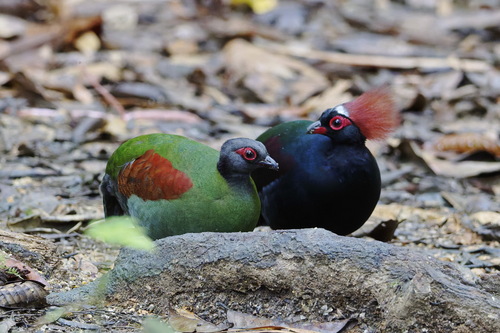
The crested partridge (scientific name Rollulus rouloul) has several other common names: crested wood partridge, roul-roul, red-crowned wood partridge, green wood quail, and green wood partridge. It is a gamebird belonging to the pheasant family Phasianidae, within the order Galliformes (the gallinaceous birds), and it is the only species in the genus Rollulus. This small partridge is a resident breeding species found in lowland rainforests in southern Burma, southern Thailand, Malaysia, Sumatra, and Borneo. Its nest is a scrape dug into the ground, lined with leaves, and hidden under a pile of leaf litter. Clutches contain five or six white eggs, which are incubated for 18 days. Unusually for a galliform species, both parents feed young directly bill-to-bill instead of the young pecking food from the ground. Though the young are precocial, they roost in the nest while they are small. The crested partridge is a rotund, short-tailed bird that measures 25 cm (9.8 in) in total length, with males being only marginally larger than females. Both sexes have a bare scarlet skin patch around the eye and red legs that lack spurs and a hind toe. Males have metallic green upperparts, glossy dark blue underparts, and a brownish wing panel. Their head has a tall red crest, a white spot on the forehead, and black frontal bristles. Females have pea-green body plumage, with the exception of their brown wing coverts. They have a slate-grey head that bears bristles, but lacks the forehead spot and crest. The bill of both sexes is entirely dark. Juvenile birds are duller versions of adult birds of the same sex. The song of the crested partridge is a mournful, whistled si-ul. Crested partridges are most often seen alone or in pairs. They use their feet to probe the forest floor for fruit, seeds, and invertebrates. When disturbed, they prefer to run away, but will fly a short distance on their rounded wings if needed. There is concern about the impact of habitat destruction, particularly logging, on this species. However, crested partridges appear to be somewhat more adaptable to change than other Southeast Asian pheasant species. As of 2021, the crested wood partridge is evaluated as Vulnerable on the IUCN Red List of Threatened Species, and it is listed on Appendix III of CITES.