About Robinia pseudoacacia L.
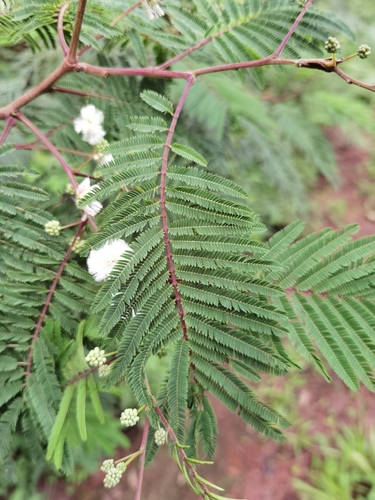
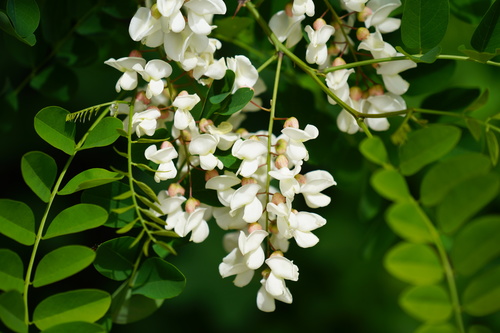
Robinia pseudoacacia L., commonly called black locust, is a member of the pea family. Its roots hold nitrogen-fixing nodules, a common trait for plants in this family. Mature black locust trees typically grow 12–30 metres (40–100 feet) tall, with a trunk diameter of 0.6–1.2 m (2–4 ft). It has a very upright growth habit with a straight trunk and narrow crown, which becomes scraggly as the tree ages. The bark is reddish black and gray, tinged red or orange in its grooves, and deeply furrowed into vertical grooves and ridges that often cross to form diamond shapes. Branches are typically zig-zag, and may be ridged and grooved or round. Young branches start out covered in white silvery down; this fades quickly, and branches turn pale green, then later become reddish or greenish brown. Black locust leaves are dark blue-green, lighter on their undersides, and are compound: each leaf holds many smaller leaflets, roughly paired on either side of the leaf’s central stem (called a rachis). It has odd-pinnate leaves, with one leaflet at the very tip of the rachis, and leaves are alternately arranged on the branch. Each full leaf is 15–36 cm (6–14 in) long and holds 9–19 leaflets; individual leaflets are 2.5–5 cm (1–2 in) long and 0.6–2 cm (1⁄4–3⁄4 in) wide. Leaflets are rounded or slightly indented at the tip, and typically rounded at the base. New leaves emerge folded in half, yellow-green, and covered in silvery down that quickly disappears. Each leaflet starts with a tiny stipel that falls off quickly, and connects to the rachis via a short stem called a petiolule. Leaves attach to branches with slender, hairy petioles that are grooved and swollen at the base. Stipules are linear, downy, and membranous when young, and occasionally develop into prickles. Black locust leaves emerge relatively late in spring, and turn clear pale yellow in autumn. Leaflets fold together during wet weather and at night (a trait called nyctinasty), a night-position habit shared by the entire legume family. Young black locust trees are often spiny, especially on root suckers and low branches; mature trees often lack spines. This species varies widely in spine number: some trees are densely prickly, while others have no prickles at all. Spines typically stay on the tree only until the thin young bark they attach to is replaced by thicker mature bark. Spines develop from stipules (small leaf-like structures at the base of leaves), and since stipules grow in pairs at leaf bases, spines are also paired at leaf bases. They grow up to 2 cm (3⁄4 in) long, are somewhat triangular with a flared base and sharp point, dark purple in color, and only adhere to the bark. Winter buds are very small, naked (with no covering scales), grouped in sets of three or four, protected in a depression by a scale-like covering lined internally with a thick layer of tomentum, and open in early spring. As buds form, they are covered by the swollen base of the leaf petiole. Large flowers open in May or June, after leaves have fully developed, and bloom for 7–10 days. Flowers grow in loose, drooping clusters called racemes that are typically 10–20 cm (4–8 in) long. Individual flowers are usually cream-white, rarely pink or purple, with a pale yellow blotch at the center, and have an imperfectly papilionaceous shape. They are around 2.5 cm (1 in) wide, very fragrant, and produce large amounts of nectar. Each flower is perfect, bearing both male stamens and female pistil. Ten stamens are enclosed within the petals, arranged in a diadelphous configuration: the filaments of 9 stamens are fused into a tube, while one stamen remains separate above the fused group. The single ovary is superior and holds several ovules. Below each flower is a calyx, a leafy tube of fused sepals between the flower and stem, that is dark green and may have red blotches. The slender pedicels (stems connecting the flower to the branch) are 1.3 cm (1⁄2 in) long, and dark red or reddish green. The fruit is a typical legume pod: flat, smooth, and pea-like, 5–10 cm (2–4 in) long and 1.3 cm (1⁄2 in) broad. A pod usually contains 4–8 seeds. Seeds are dark orange brown with irregular markings, ripen late in autumn, and hang on branches until early spring. There are typically 25,500 seeds per pound. Seedling cotyledons are oval and fleshy. The genus Robinia is native to North America, though fossil traces of the genus have been found in Eocene and Miocene rocks in Europe. The species R. pseudoacacia is native to the eastern United States, but its exact native range is not well known because it has been widely cultivated; it now grows across all 48 contiguous U.S. states, British Columbia, and eastern Canada. Its native range is thought to consist of two separate populations: one centered on the Appalachian Mountains from Pennsylvania to northern Georgia, and a second western population focused on the Ozark Plateau and Ouachita Mountains of Arkansas, Oklahoma, and Missouri. The species has become naturalized in temperate North America, Eurasia, and Africa after being spread by humans for landscaping. Its current introduced range includes Canada, Southern South America, Europe, temperate regions of Asia (including China, India, and Pakistan), Northern and Southern Africa, Australia, and New Zealand. Black locust reproduces both sexually through flowers, and asexually through root suckers. Insects, primarily Hymenopteran insects, pollinate the flowers. The structure of the flower separates male and female parts, so self-pollination does not usually occur. Seedlings grow rapidly, but the thick seed coat prevents many seeds from germinating. The seed coat can be weakened by hot water, sulfuric acid, or mechanical scarification, which increases germination rates. Good seed crops are produced every year or every other year. Root suckers are an important method of local reproduction for this tree. Roots can grow suckers either after damage (such as from a lawn mower) or without damage. Suckers are stems that grow directly from the roots up into the air, and can develop into full mature trees. The main trunk can also grow new sprouts after being cut down. This makes black locust very difficult to remove, as suckers must be repeatedly removed from both the trunk and roots to prevent the tree from regrowing. Sucker production allows black locust to grow into colonies that often exclude other plant species, forming dense thickets that shade out competing vegetation. Black locust can have either 2n=20 or 2n=22 chromosomes. Black locust is a shade-intolerant species, so it is typically found in young woodlands and disturbed areas with abundant sunlight and dry soil. Because of this and its spread via underground suckers, it is often considered a weedy tree. When growing in sandy areas, its nitrogen-fixing root nodules enrich the soil, allowing other plant species to become established. On sandy soils, it can replace other vegetation that cannot fix nitrogen. It is a typical early successional pioneer species, growing best in full sunlight and poorly in shade. It specializes in colonizing disturbed areas and woodlot edges, before it is eventually replaced by taller or more shade-tolerant species. It prefers dry to moist limestone soils, but will grow in most soil types as long as they are not wet or poorly drained. It tolerates a soil pH range of 4.6 to 8.2. Within its native range, it grows on Inceptisols, Ultisols, and Alfisols soil groups, but does not grow well on compacted, clayey, or eroded soils. It is a component of Appalachian mixed mesophytic forests. Black locust is a host plant for up to 67 lepidoptera species. When planted on previously open land, it provides valuable wildlife cover. Its seeds are eaten by bobwhite quail, other game birds, and squirrels. Older trees are often infected with heart rot, so woodpeckers may nest in their trunks. Its deeply furrowed bark also makes it a preferred roosting species for some bats. The bark, leaves, and wood of black locust are toxic to both humans and livestock. Key plant compounds are the toxalbumin robin, which loses its toxicity when heated, and robinin, a nontoxic glucoside. Horses that consume the plant develop symptoms of anorexia, depression, incontinence, colic, weakness, and cardiac arrhythmia. Symptoms usually appear around 1 hour after consumption, and immediate veterinary care is required. Sawdust and shavings made from black locust lumber can cause contact dermatitis in sensitive people. Black locust can be easily propagated from roots, softwood cuttings, or hardwood cuttings. Cultivars may be grafted to ensure offspring are genetically identical to the parent plant. In Europe, it is often planted along streets and in parks, especially in large cities, because it tolerates air pollution well.