About Ripogonum scandens J.R.Forst. & G.Forst.
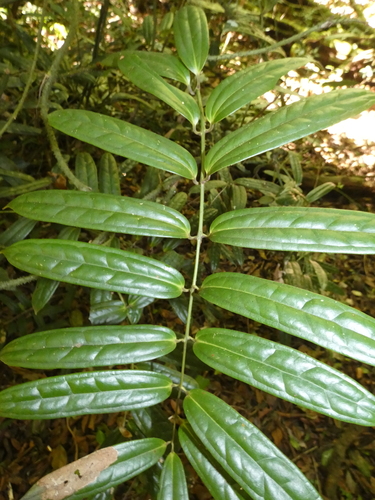
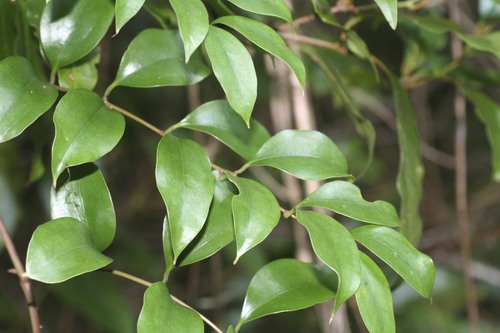
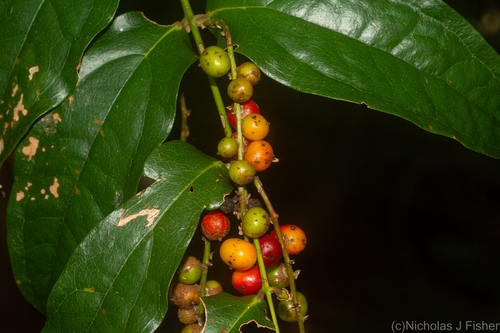
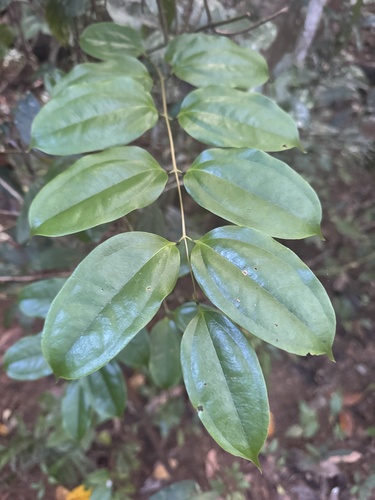
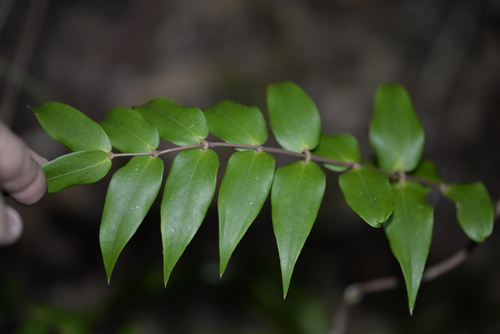
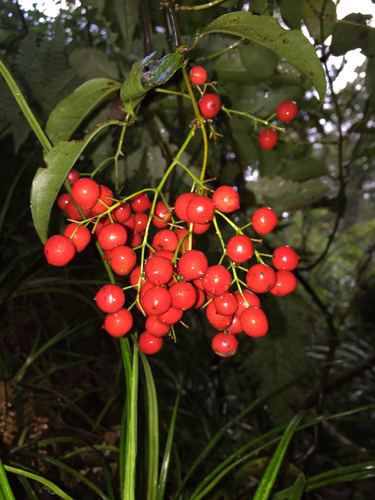
Ripogonum scandens, commonly called supplejack, is an evergreen climbing forest liane that can reach lengths of up to 18 metres (60 feet). It has stout, woody rhizomes 30–60 mm (1.2–2.4 in) in diameter. Its stems are several metres long, around 15–20 mm (0.59–0.79 in) in diameter, almost black, rarely branched, with nodes spaced 100–200 mm (3.9–7.9 in) apart. Leaves are mostly arranged oppositely, usually 55–160 mm long and 20–60 mm wide, variable in green colour, leathery (coriaceous), and shaped from narrow-ovate to oblong. Petioles are around 10–15 mm long. Flowering typically happens in December and January. Inflorescences (flower clusters) are 100–150 mm (3.9–5.9 in) long, and pedicels are about 5–9 mm (0.20–0.35 in) long. The spreading tepals are green. Filamentous stamens are about 2 mm (0.079 in) long. Anthers are greenish to yellow, linear-oblong, and measure approximately 3.0–5.0 × 1.0–1.5 mm. Ovaries are globe-shaped, around 1.5 mm (0.059 in) in diameter. Fruiting typically starts from March onwards. Fruits are also globe-shaped, bright red, 10–15 mm (0.39–0.59 in) in diameter, with thin, fleshy pericarps. R. scandens has a diploid chromosome count of 22. This species is endemic to New Zealand, found across the North and South Islands, as well as the offshore Stewart and Chatham Islands. It occurs throughout most of the North Island. In the South Island, its range is concentrated mostly on the western coast, with scattered populations on the eastern coast. Throughout Marlborough, Canterbury and Otago, it occurs sparingly in old-growth forest relics, and is found mainly on peninsulas including Kaikōura, Banks, and Otago. Additional inland populations have been recorded near Winton and Geraldine. It is abundant on Stewart Island. In the 2023 New Zealand Threat Classification System assessment, R. scandens was classified as "Not Threatened". R. scandens grows most commonly in coastal to montane forests, and tends to be most abundant in forests dominated by hardwoods and podocarps. In Fiordland, it is commonly associated with beech (Nothofagus). The maximum recorded altitudinal range is 900 m (3,000 ft) in the North Island and 570 m (1,870 ft) in the South Island. It can grow in a wide range of soil types including loam, pumice, and alluvial soils, and can tolerate swampy forest conditions with occasional flooding. It grows in both full sun and shaded locations. The fruits of R. scandens are dispersed by frugivorous (fruit-eating) animals, including many native and introduced bird species. Known consumers of its fruit include kererū (Hemiphaga novaeseelandiae), blackbirds (Turdus merula), and tūī (Prosthemadera novaeseelandiae); the fruit is also one of the main winter food sources for the North Island kōkako (Callaeas wilsoni). In addition to fruit, kererū also feeds on the adult leaves of this vine. R. scandens is pollinated by either insects or wind. A 1972 observation by MacMillan noted that some flowers have underdeveloped ovaries, which enables self-pollination. This vine hosts two aphid species from the genus Aulacorthum. It also acts as a host for several moth species found in New Zealand. Larvae of Ctenopseustis obliquana feed on the vine's stems, leaves, flowers and fruit. Larvae of Epalxiphora axenana feed beneath cataphylls, chewing vine tissue and stems. Oemona hirta also uses R. scandens as a host. Cattle, deer, feral pigs, possums, and rats eat the fruits and other parts of the plant. The plant pathogen Peniophora sacrata is hosted by R. scandens. New Zealand botanist G. H. Cunningham recorded multiple species of Thelephoraceae and two species of Polyporaceae that grow as saprobes on dead R. scandens stems. Additional fungi recorded on the species include Acrogenotheca elegans, species of Septobasidium, and species of Wallrothiella. Research by MacMillan (1972) found that during December and January, growing tips of R. scandens can grow an average of 5 cm (2.0 in) per day.