About Riopa punctata (Linnaeus, 1758)
Description
Juvenile Tail Traits
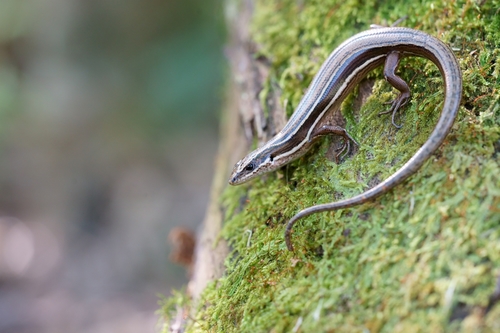
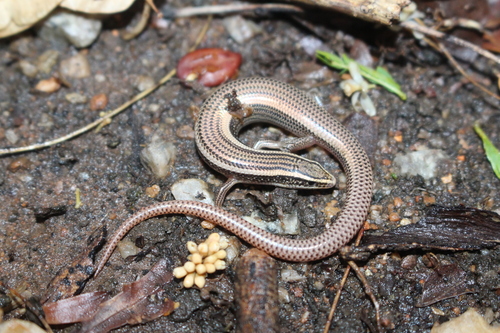
Young skinks of this species have a distinctive red tail, which adult individuals of the species lose. As the skink ages, the former red tail is replaced by small spots, and these spots grow together to form continuous lines. The spots are present on the head and extend onto the snout.
Snout and Limb Proportion
The distance between the end of the snout and the fore-limb is about two-thirds of the distance between the axilla and groin. The snout is obtuse, and the lower eyelid has an undivided semitransparent disc. The supranasals are entire and contact one another behind the rostral.
Head Scale Features
The frontal is longer than the frontoparietals and interparietal combined. A pair of nuchals is present, and rarely absent. One enlarged temporal scale borders the outer margin of the parietal.
Ear and Labial Traits
The ear-opening is about half the size of the eye-opening, with one or two minute lobules on its anterior side. There are 7 supralabials, with the fifth positioned below the middle of the eye, and it is longer than the adjacent labials.
Body Scale Characteristics
The body is covered with smooth, subequal scales. There are 24 or 20 scales around the body, rarely 28, and 62 to 76 scales down the middle of the back. The marginal preanals are slightly enlarged.
Limb and Digit Traits
When pressed against the body, the adpressed limbs do not meet, and the gap between them is nearly twice the length of the fore-limb. The digits are long, with the fourth toe distinctly longer than the third. There are 11 to 14 keeled lamellae under the fourth toe.
Adult Tail Traits
The tail is thick at the base, and is a little longer than the combined length of the head and body.
Dorsal Coloration
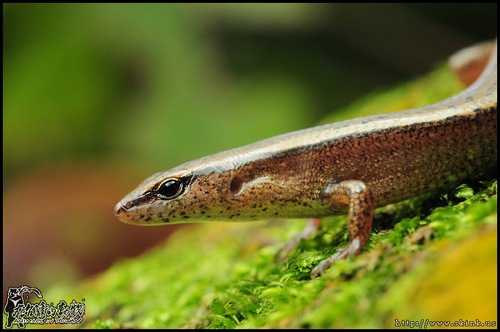
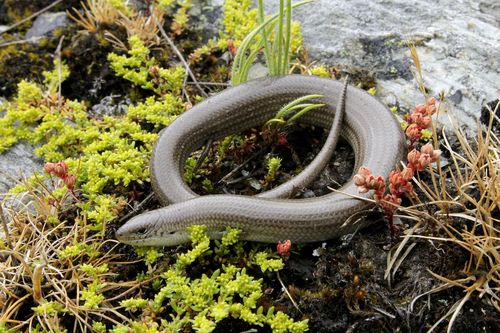
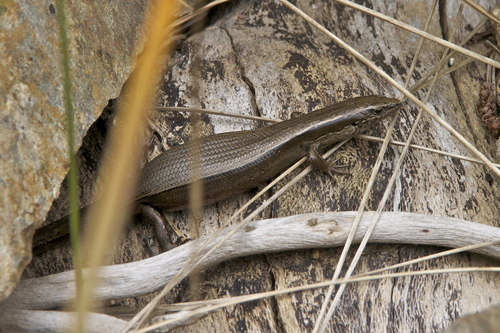
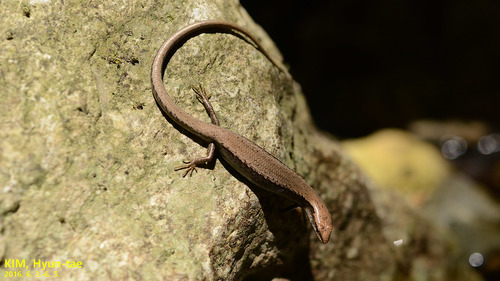
The upper body and sides are brown. Each scale has a dark basal spot. In young skinks, the spots join together to form 4 or 6 longitudinal lines running down the back.
Juvenile Markings
A strongly marked yellowish dorsolateral streak starting on the canthus rostralis is present in young individuals. The lower surfaces of the body are yellowish-white and uniform, or each scale has a black central dot. The tail is reddish in young individuals.
Distribution
Country Range
This species is found in Bangladesh, Nepal, Pakistan, Vietnam, India and Sri Lanka.
Regional Habitat Locations
It occurs mostly in hilly regions, including the Yelagiris, Nilgiris, Sivagiris, Shevaroy Hills, Nilambur, Madurai, Cuddapah, Salem, Belgaum, Godavari districts, Chaibassa, Bilaspur, Rewa, Allahabad, Hazara, Meerut, and Subathu (Simla).