About Ridgwayia pinicola (P.L.Sclater, 1859)
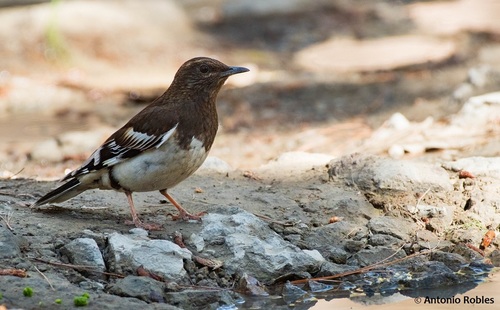
The Aztec thrush, scientifically named Ridgwayia pinicola (P.L.Sclater, 1859), measures 21.5–24 cm (8.5–9.4 in) in length and weighs 67–88 grams (2.4–3.1 oz). Adult males have a dark brown hood covering their head, neck, and upper mantle that is marked with pale flecks or streaks, and they may also have a pale brown supercilium. Their back, scapulars, median coverts, and greater coverts are dark brown; greater coverts have white edges. Primary coverts are black with grey tips, and flight feathers are black with some white patches. The underwing's lesser and median coverts are white, while the greater underwing coverts are blackish grey. The tail is black or blackish brown with whitish grey tips. The breast is dark brown, and all other underparts are white. Adult males have a dark brown beak and pale pink legs. Females are paler than males, lack the dark brown hood, and have larger streaks on their plumage. Juvenile Aztec thrushes are overall blackish, with golden-buff markings on their head and back. They have a cinnamon or reddish-brown lower back, a black tail, and scaled underparts. This species is native to Mexico, where it lives in mountain areas between 1,800–3,500 m (5,900–11,500 ft) above sea level. Its primary habitat is ravines within pine and pine-oak forests. It occurs as a vagrant in the region from western Texas to southeastern Arizona in the United States. The first recorded observation of the species in the United States was an immature individual seen in 1977 at Big Bend National Park, Texas.