About Rhyothemis fuliginosa Selys, 1883
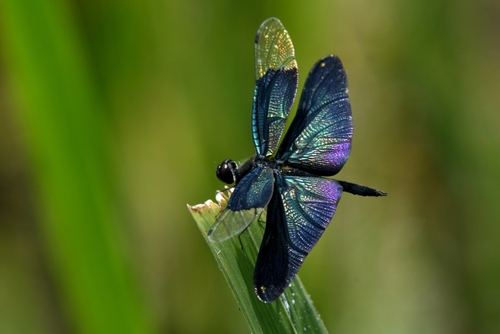
Rhyothemis fuliginosa is a short, stout dragonfly. It has a body length of 32 to 41 millimeters, and a wingspan of 30 to 40 millimeters. Its wings are patterned with a deep blue iridescent shade. Due to the light scattering properties of the wings, their visible color changes depending on the viewing angle, and some wings appear golden when in direct light. Researchers believe the wing patterns help members of this species recognize one another to avoid mating with the wrong partner. Males have distinct spots on the tips of their hindwings, which is the main feature used to tell males and females apart. Specimens collected from southern Japan have spotted forewings and fully pigmented hindwings. This species is distributed across East Asia, with confirmed populations in China, Japan, Taiwan, and the Korean Peninsula. Its range also extends south into Vietnam. In Japan, it is found across the main island of Honshu, as far north as Aomori Prefecture, and as far south as Kagoshima Prefecture on the island of Kyushu. Overall, it occurs throughout the Japanese islands of Honshu, Shikoku, and Kyushu. There are unconfirmed reported sightings of this species further north, on the island of Hokkaido. Its range also extends to offshore islands of the Japanese mainland, such as Tanegashima. In mainland China, it has been recorded in Guangdong, Hebei, Henan, Hunan, Jiangsu, Jiangxi, Shaanxi, Shandong, Sichuan, and Zhejiang provinces. There are unconfirmed sightings in Hainan province. In Taiwan, it is a rare vagrant, with the first confirmed recorded sighting dating to 2007. Four other species of the genus Rhyothemis—Rhyothemis regia, Rhyothemis severini, Rhyothemis triangularis, and Rhyothemis variegata—occur across Taiwan in the absence of R. fuliginosa. Rhyothemis fuliginosa, commonly called the butterfly flutterer, prefers inland freshwater wetlands, and is especially associated with wetland areas that have aquatic plants. Its known habitats include marshes, swamps, permanent freshwater lakes, permanent freshwater marshes, artificial ponds, and aquaculture ponds. It has been observed flying in plains, mountainous areas, hills, and satoyama watersides. Because of their flight ability, adult R. fuliginosa can travel further outside their core wetland habitats. In the evenings, adults move into forests to rest in the tree canopy. Rhyothemis fuliginosa feeds on flying insects, and particularly favors mosquitoes as prey. Mating is brief, and egg laying begins almost immediately after mating. Females deposit eggs directly on the surface of freshwater bodies. This species overwinters in its larval stage, when larvae feed on small insects. The species was previously recorded to exhibit swarming behavior. However, due to habitat loss, pollution from insecticide use, and increasing urbanization, R. fuliginosa has experienced significant population decline in Japan. Populations have become visibly smaller, and the species is growing less abundant in Japanese metropolitan areas.