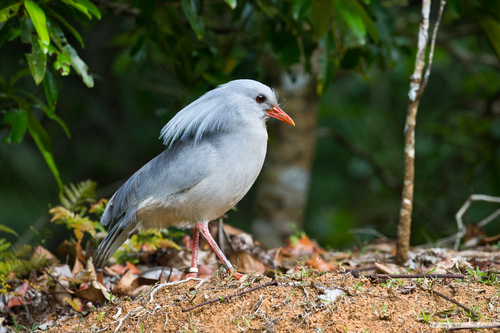
About Rhynochetos jubatus J.Verreaux & Des Murs, 1860
Taxonomy and Size
The kagu, scientifically named Rhynochetos jubatus J.Verreaux & Des Murs, 1860, is a ground-living bird that reaches 55 cm (22 in) in length. Individual weight varies considerably based on the bird and season, falling between 700–1,100 g (25–39 oz).
Plumage and Sexual Dimorphism
Its ash-grey and white plumage is unusually bright for a forest floor bird. There is very little sexual dimorphism in this species, with the only notable difference being the amount of barring on the primary feathers.
Powder Down Function
Kagus have powder down, which keeps them dry and insulates them against the temperature extremes of New Caledonia's tropical climate.
Display Crest
Their display crest is barely noticeable when the bird is at rest, but can be erected and fanned out to communicate with other kagus.
Flight Capability
Kagus are nearly flightless; they use their patterned primary wings for displays and to help them move quickly through the forest, and can also glide when fleeing danger.
Wing Structure
Unlike the wings of most other flightless birds, kagu wings are not reduced in size, reaching a wingspan around 77.5 cm (30.5 in), but they lack the musculature required for powered flight.
Broken-Wing Display
Kagus also use their wings for a "broken-wing" display, a behavior also seen in their relative the sunbittern, where the bird fakes an injury to draw a predator's attention away from its chick.
Leg Morphology
They have long, strong, bright red legs that let them travel long distances and run quickly.
Eye Adaptations
Their large eyes are positioned to give good binocular vision, which helps them locate prey in leaf litter and see in the dim light of the forest.
Unique Nasal Corns
Kagu have unique nasal corns, structures that cover their nostrils that no other bird species has; these are thought to keep soil particles from entering the nostrils when the kagu probes soil to feed.
Blood Cell Trait
Another unique trait of the species is that it has only one-third the number of red blood cells that are typical for birds, but three times more hemoglobin per red blood cell than usual.
Endemic Range
The kagu is endemic to the forests and shrubland of New Caledonia, and is restricted to the main island of Grande Terre within that island group.
Fossil Distribution
There is no evidence that kagu ever occurred on the Loyalty Islands, though fossil remains of the extinct lowland relative R. orarius have been found on the Isle of Pines.
Forest Habitat Adaptability
Kagu are habitat generalists that can survive in a range of forest types when enough prey is available, from rain forest to drier lowland forest.
Shrubland Habitat Tolerance
They can also forage in some of the drier shrubland found on the island's ultramafic rocks, but cannot live in the poorest, low-prey shrubland of this type.
Unsuitable Habitat
They are not found in areas with extensive ground cover that makes foraging difficult, such as grassland or areas with dense fern cover, but may travel through these areas to reach other foraging grounds.
Range Contraction Causes
The species' range has contracted over time due to hunting and predation by introduced species.
Prehistoric Distribution Research
The original prehuman distribution of the kagu, and the extent to which it and its sister species R. orarius coexisted in New Caledonia's lowland areas, are not yet fully understood and require further research into the subfossil record.
Territorial Range
Kagu are territorial, and maintain year-round territories covering 10–28 hectares (25–69 acres).
Social Structure
The species has a clan-based social structure, where family groups are made up of one breeding female and one to three breeding males. Male offspring also help defend their parents' territorial claims.
Polyandrous Behavior Trigger
In recent years, dog attacks have disrupted the kagu's social organization; when either the breeding male or female is killed, nonfraternal polyandrous behavior can occur.
Polyandry Prevalence
Cooperative and unrelated polyandry is rare among birds, but has also been recorded in species like the dunnock and the Tasmanian nativehen.
Nonbreeding Season Spacing
Within their territories, pairs are solitary during the nonbreeding season, and often have separate but overlapping foraging areas.
Vocalizations
Kagu make a variety of different sounds, most commonly during morning duets that each last around 15 minutes.
Display Variation
Kagu use their crests and wings for territorial displays toward other kagu, and use slightly different displays toward potential predators.
Territorial Disputes
Territorial disputes may be settled with fighting that uses the wings and bill, though this rarely causes serious injuries in wild populations.


