About Rhynchospora alba (L.) Vahl
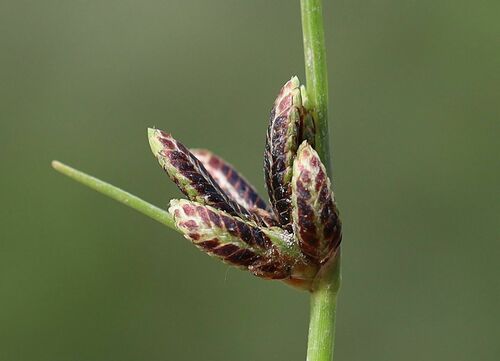
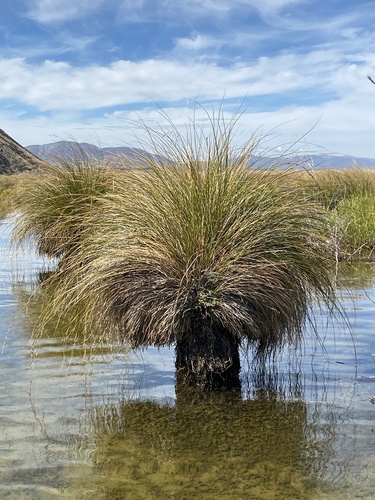
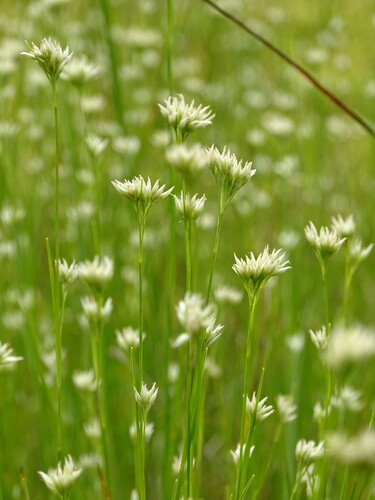
Rhynchospora alba, commonly called white beak-sedge, is a perennial herb that typically grows 10 to 50 centimeters tall, though North American specimens may reach up to 75 centimeters in height. It grows in dense tight clumps, which often makes it hard to tell apart individual stems. Each plant produces a single thin, three-angled erect stem that is usually 0.5–1 mm thick. Leaves growing on the stem are arranged in three ranks, spiraling around the three edges of the stem, are parallel-veined, and can grow up to 15 cm long, but none grow taller than the main stem. Each leaf is divided into two parts: a green or straw-colored sheath that wraps tightly around the stem, and a gray-green flat, slender blade that measures 0.7–2 mm wide and tapers to a blunt tip. On some individual plants, the blade margins are covered in sparse hairs. Unlike many other sedge species, this species does not have a ligule, the outgrowth found at the junction of the leaf blade and sheath. At the base of the plant, leaves only produce sheaths, with no blade present. These basal sheaths often subtend a 10–20 mm overwintering bud that grows into a new plant the following spring. While most species in the Rhynchospora genus have large, tuber-like underground rhizomes, R. alba has very small rhizomes or no rhizomes at all, and only a very shallow root system. This difference matches its distinct life history compared to many other sedges: R. alba loses all above-ground and below-ground structures except for its basal overwintering bud over the winter, while most other sedges retain nutrient-storing rhizome and root structures through the winter. Rhynchospora alba prefers acidic, nutrient-poor conditions, and grows across a variety of wetland habitats. It is most common in ombrotrophic bogs, where plants get all their nutrients from rainfall and dry deposition, and in communities dominated by Sphagnum moss, where it is one of the few vascular plant species present. Studies of nutrient and mass allocation in R. alba found that this species has much higher rates of nutrient accumulation and nutrient loss over the growing season than other sedges, which rely more on storing and remobilizing nutrients in their rhizomes. This difference is likely tied to the much lower levels of interspecific competition R. alba experiences in these bogs, compared to competition levels for other sedges that live in more grass-dominated environments. It can also be found in peatlands growing alongside other sedge species, including various Carex species. It forms a persistent seed bank, with its seeds remaining viable for up to five years. Because of this, it is often an early re-colonizer of disturbed wetland environments, and can become the dominant species in plant communities called R. alba sedgeland. However, it is much less dominant in more established plant communities, since it is less able to outcompete other sedge species that have more developed root and rhizome systems. R. alba is pollinated by wind and its seeds are dispersed by wind, so it has few close interactions with insect pollinators. It is a major food source for a number of bog-dwelling species, including Paraphlepsius leafhoppers in the United States. While most species in the Rhynchospora genus are native to tropical regions, R. alba is restricted to higher latitudes of the Northern Hemisphere, where the climate supports the formation of bogs and fens. It has a wide boreal distribution, and is commonly found in the United States north of California and South Carolina, Canada, Europe, the Caucasus, China, Japan, and the Korean Peninsula. It generally grows at altitudes below 850 m, but has been recorded at higher altitudes along the southern edge of its range, for example in China and Puerto Rico. Humans use white beak-sedge very little, due to its preference for nutrient-poor acidic bogs that are not commonly used for human activities. It is sometimes grown as an ornamental plant in the United Kingdom, and is used in bog restoration projects.