About Rhynchocalamus melanocephalus (Jan, 1862)
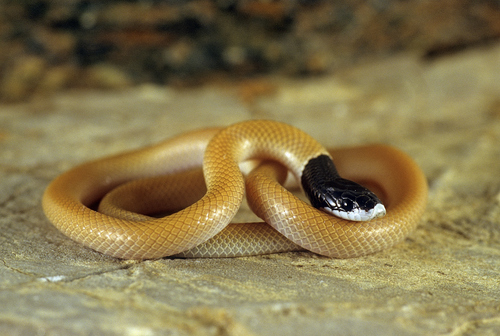
Rhynchocalamus melanocephalus, commonly called the black-headed ground snake, is a small, slender-bodied burrowing species that reaches a total length of 36–40 cm (14–16 in, including body and tail). Its dorsal scales are smooth and shiny, and covered by an almost transparent outer layer that makes many internal organs clearly visible when the snake is held against a light source. It has small eyes with black irises, and its head is covered in large, symmetrical shields. The rostral shield is somewhat enlarged and adapted for digging through soil. Dorsal body color ranges from tan to orange, with no distinct pattern except on the head and neck; the belly is solid clear white. Head and neck patterning differs between the two recognized subspecies. In the nominate subspecies, Rhynchocalamus melanocephalus melanocephalus, the neck pattern and head pattern are not separated. The entire upper surface of the head and neck is ash-black, and only the labial, nasal, and rostral scales are white. In Rhynchocalamus melanocephalus satunini, a black semi-collar is present on the neck, and the head patterning is made up of three transverse black saddles. The first saddle sits on the rostral scale. The second extends across the postnasal, supraorbital, and frontal scales, and partially across the prefrontal shields from eye to eye. The third saddle covers the parietal shields and some of the adjacent surrounding scales. The white areas between the black saddles allow this species to be visually distinguished from similar-looking snakes in the genera Eirenis and Pseudocyclophis, which often share the same habitat. This species occurs in dry shrublands of Eastern Mediterranean and Near Eastern countries, with confirmed records from Armenia, Azerbaijan, Israel, Iran, Iraq, Jordan, Lebanon, Saudi Arabia, Syria, and Turkey; it was formally recorded in Cyprus in 2013. The nominate subspecies occupies the southern portion of the species' overall range, while populations from Armenia, Azerbaijan, northeastern Turkey, and northwestern Iran belong to the subspecies Rhynchocalamus melanocephalus satunini. The black-headed ground snake inhabits rocky, clayey semideserts. It spends most of its time underground, and is rarely found under rocks after heavy rains during spring and early summer. Much of this snake's native habitat has been converted to irrigated agricultural land or urban areas. In many regions, the semidesert habitat it relies on is also used as pasture for domestic goats, sheep, and cattle.