About Rhus michauxii Sarg.
Rhus michauxii Sarg. is a rare flowering plant in the cashew family, commonly called false poison sumac and Michaux's sumac. It is endemic to the southeastern United States, occurring in Virginia, North Carolina, South Carolina, and Georgia. It is threatened by habitat loss, habitat degradation, and barriers to reproduction, and is a federally listed endangered species of the United States.
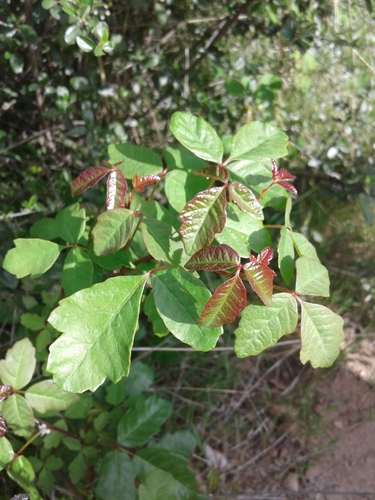
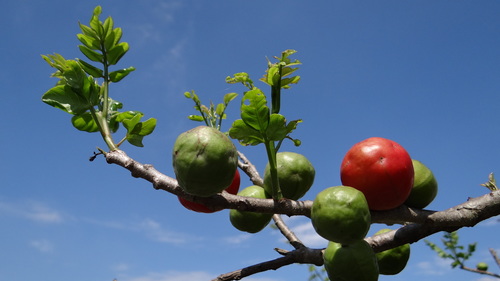
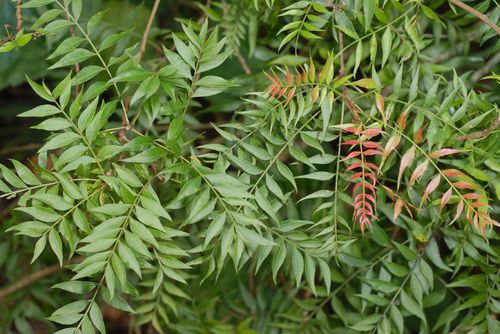
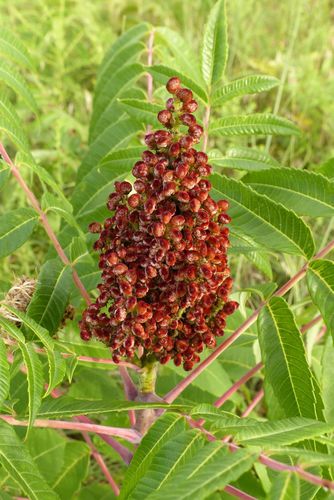
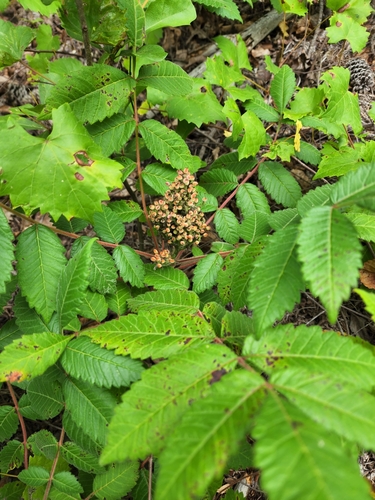
This plant is a small shrub that grows 30 to 60 centimeters (12 to 24 inches) tall. It has a very hairy texture, and its small size and hairiness set it apart from other sumacs. Its long leaves are each made up of several pairs of toothed leaflets. The species is dioecious, meaning male and female reproductive parts grow on separate individual plants. In June, the plant produces an erect inflorescence of white or greenish yellow flowers. On female plants, these flowers develop into red drupes from late summer to early fall.
The species was first described as Rhus pumila by André Michaux in 1803, and was renamed to honor Michaux in 1895. This shrub grows in wooded areas, most often on clay or decomposed granite soils; it also occurs in sandhills habitat on loamy soils. Its habitat may be dominated by longleaf pine and oaks, and it commonly grows alongside Ceanothus americanus, Paspalum bifidum, Tridens carolinianus, Aristida lanosa, Onosmodium virginianum, and Helianthus divaricatus. Other known associated species that indicate this plant's presence include Liquidambar styraciflua, Cornus florida, Rhus glabra, R. copallinum, Schizachyrium scoparium, Sorghastrum elliottii, Brickellia eupatorioides, Eupatorium godfreyanum, E. sessilifolium, Silphium compositum, Helianthus divaricatus, Helianthus strumosus, Viburnum rafinesquianum, Scleria oligantha, Clematis ochroleuca, Sanicula smallii, Salvia urticifolia, and Parthenium auriculatum. This plant's habitat is generally somewhat more moist than the surrounding landscape, and the species requires vegetation openings to receive adequate sunlight.
Half of all recorded populations of this plant have been extirpated. Much of its original habitat has been cleared for residential, industrial, and agricultural operations (including silviculture), as well as road construction. Remaining habitat is degraded by the loss of a normal fire regime. This plant does not tolerate shade, and naturally grows in vegetation openings maintained by wildfire. Modern fire suppression prevents the natural periodic wildfires the plant depends on, leading to overgrowth of vegetation that shades out this rare shrub.
The species also faces significant difficulties with reproduction. It is clonal and often reproduces vegetatively, so populations have very low genetic variability. It can hybridize with the common Rhus glabra to form the natural hybrid Rhus × ashei. A major barrier to sexual reproduction is that many populations are made up entirely of a single sex. Additionally, existing populations are small and very widely spaced, making successful sexual reproduction impossible. Because the species requires open habitat, it may become established in artificially cleared areas such as roadsides, where it is vulnerable to destruction from construction, road maintenance, and herbicide use.
Current conservation activities for this species include genetic analysis to better understand genetic variability within populations. Plant propagation techniques are under study, and plants are being reintroduced to appropriate habitat, including the introduction of opposite-sex plants into single-sex populations. Plants from high-risk areas are also transplanted to more suitable habitat to support their survival. Prescribed burns are used to create the open vegetation openings where the species can thrive.