About Rhus integrifolia (Nutt.) Benth. & Hook.fil. ex Brewer & S.Watson
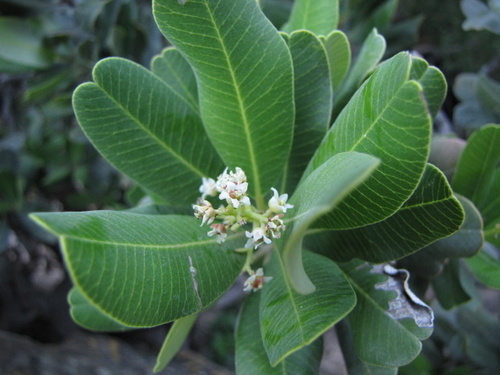
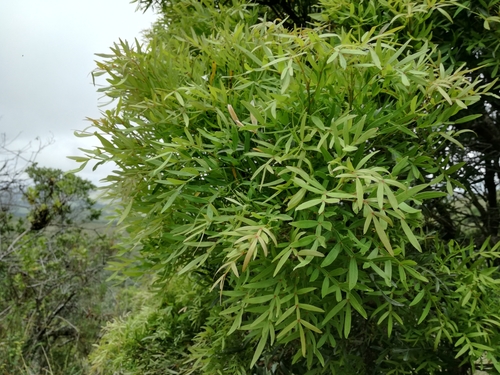
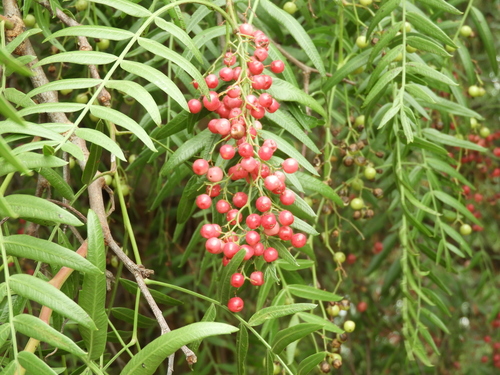
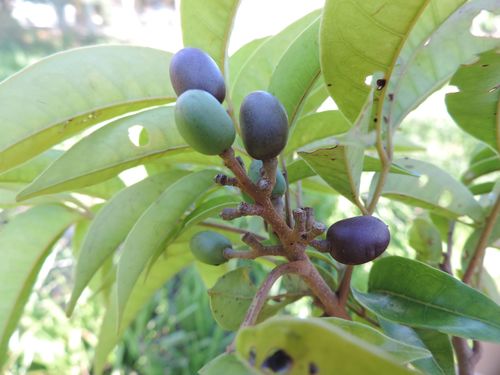
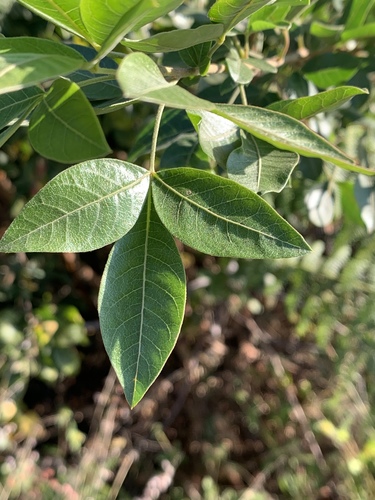
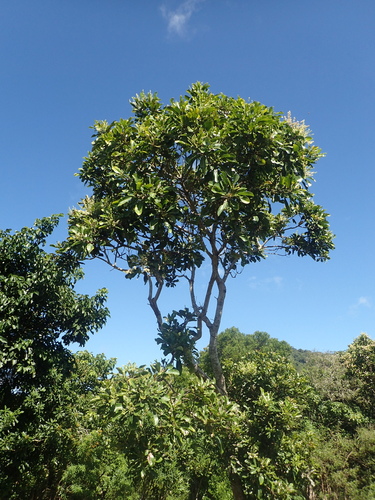
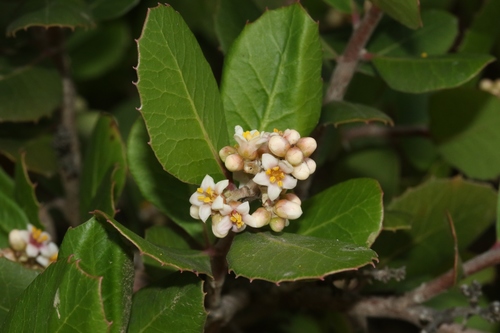
Rhus integrifolia, commonly called lemonade berry, has simple leaves, which is unusual for the Rhus genus, where most species have trifoliate leaves. Its leaves are alternating, evergreen and leathery, measuring 5 to 7 centimeters long and 2 to 4 centimeters wide, growing on reddish twigs. Leaf margins are toothed; the upper leaf surface has a waxy, smooth appearance, while the lower surface is paler in tone. Flowers appear from February to May; they are small, closely clustered, and may be either bisexual or pistillate. These fragrant flowers have radial symmetry, with five green sepals, five white to rosy-pink petals, and five stamens. Individual small flowers measure only six millimeters across. The ovary is superior and usually holds a single ovule; in pistillate flowers, the stamens are small and infertile. Mature fruit of Rhus integrifolia is sticky, reddish, covered in hairs, and about 7 to 10 millimeters in diameter. The elliptical fruit grows in tight clusters at the very ends of twigs. Young plants have smooth reddish bark, while more mature individuals develop cracked, even scaly, grayish bark, with the smooth red bark visible underneath. Twigs are fairly stout and flexible, with small, pointed reddish bud ends. The plant often has a multi-furcate branching structure starting from its base. A mature plant is large, thicket-forming, with a sprawling growth habit. Lemonade berry grows on north and east-facing slopes and canyon floors in coastal areas of southern California and northern Baja California; one colony has been observed as far north as Santa Cruz County. It grows in both chaparral and coastal sage scrub plant communities. This species grows well in well-drained soils, and tolerates heat, wind, sandy soils, medium loam soils, and even nutrient-deficient soil. It tolerates pH conditions from mildly acid to mildly alkaline, and is common on shady, moist north and east-facing slopes. It propagates by seed or by rhizome. Birds eat its fruits and act as a major seed disperser. Rhus integrifolia is not frost tolerant, but it will hybridize with the frost-tolerant Rhus ovata (sugarbush) in overlapping ranges in the foothills of California and Mexico. The berries, technically drupes, of this species can be used to make lemonade-flavored drinks, which gives the plant its common name. Skin contact with sap from plants in this genus may cause allergic reactions in some people. Lemonade berry leaves are rich in tannins. Although the species is evergreen, it sheds some of its leaves in autumn; fallen leaves can be used to make a brown dye or act as a mordant. An oil can be extracted from lemonade berry seeds; this oil forms a tallow-like consistency when left standing. The resulting product can be used to make candles that burn brightly, though they give off a pungent scent. The wood of mature plants is dense and hard, so it is valued as kindling for wood-burning fireplaces. Rhus integrifolia is grown as a landscape shrub, and is suitable for hedging and espalier. While the plant is vulnerable to frost, it often regrows by summer even after it appears to have been killed by cold damage. Its growth rate is slow to moderate. As a garden plant, it is quite resistant to deer, provides nectar and fruit for birds, and supplies nectar for butterflies. Its cultivation needs match its natural habitat: it requires ample drainage and little summer water.