About Rhopalostylis sapida H.Wendl. & Drude
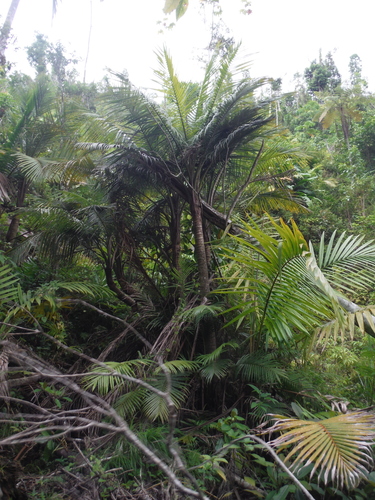
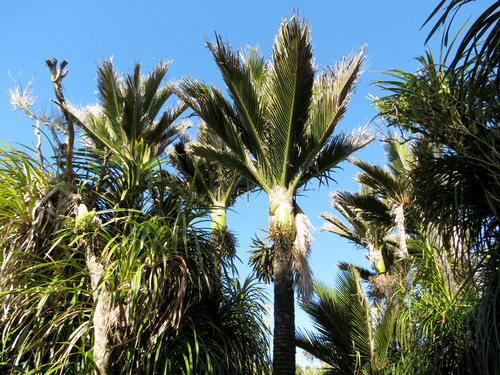
This species is scientifically named Rhopalostylis sapida H.Wendl. & Drude, and is commonly known as nīkau. Nīkau palms can grow up to 15 m (49 ft) tall, with a stout green trunk that bears grey-green leaf scars. The trunk is topped by a smooth, bulging crownshaft that reaches up to 1 m (3 ft 3 in) long. Its fronds grow up to 3 m (9.8 ft) long, and the closely set, sometimes overlapping leaflets are up to 1 m (3 ft 3 in) long. The multibranched inflorescence measures 20–40 cm (7.9–15.7 in) long. Tightly packed unisexual flowers range in color from lilac to pink; male flowers grow in pairs and have six stamens, while female flowers grow solitary. The fruit is elliptic or oblong, generally measuring around 10 by 7 mm, and turns red when ripe. Nīkau produce flowers between November and April, and fruit takes almost a full year to ripen, becoming ripe from February to November. The nīkau palm is the only palm species endemic to mainland New Zealand. Its natural habitat is coastal and lowland forest across the North Island. On the South Island, its natural range extends as far south as Ōkārito (43°20′S) on the west coast and Banks Peninsula (43°5′S) on the east. It also grows on Chatham Island and Pitt Island/Rangiauria, located to the south-east of New Zealand, where it grows at 44° 18'S latitude, making it the world's southernmost palm. While tropical plants were more widespread in New Zealand during past geologic epochs, Rhopalostylis sapida is the only member of the palm family Arecaceae that survived the ice ages on mainland New Zealand. Nīkau palm kernels are an important food source for native New Zealand birds kererū and kākā. The fungal pathogen Pseudocercospora arecacearum can be found growing on the palm's fronds. Nīkau make excellent hardy potted plants, and tend to grow slowly. They grow readily from seed when the fruit is soaked in water for a few days, then gently scrubbed to remove the outer flesh. Prepared seeds germinate readily when placed in sealed plastic bags kept in partial shade, after which they can be planted into deep pots. Pots should be tall and narrow to accommodate the developing taproot and reduce the risk of root damage during transplanting. Transplanting juvenile nīkau is generally successful if the main root is kept intact. Nīkau do not have a true tap root; once the main root is established at a fairly shallow depth of about 400 mm (16 in), roots develop in a form consistent with other palms. Successful transplanting of larger specimens is possible, but nīkau are very unreliable if any trunk has already formed. Transplanting is best done in summer, and a substantial root ball must be preserved. Newly transplanted palms should be given shade at the new location, which can be achieved at minimum by tying outer fronds closer to the center of the palm. Ground watering is recommended, because watering the crown can cause terminal rot in the very slow-growing new growing spike. Delays should be avoided when moving nīkau into their new location, and substantial die-back of all fronds except the central growing spike can be expected after transplanting. Nīkau thrive in cool temperatures, but do not typically experience freezing weather in their natural habitat. They can survive a few degrees of frost, but are more severely damaged by sudden large temperature drops, even when temperatures stay above freezing. Nīkau grow well in areas with a mild Mediterranean climate. Māori people have many traditional cultural uses for nīkau. The bases of the inner leaves and young flower clusters are a traditional food, eaten either raw or cooked. Māori wrapped food in nīkau leaves for cooking, and used old fibrous leaves to make kete baskets, floor mats, and waterproof thatch for buildings. Nīkau is a versatile weaving material, as its fibers can be used raw with no processing required. The heart of the palm, called rito, is a traditional delicacy that is only rarely eaten, because harvesting it kills the entire tree. Rito is used in traditional rongoā Māori medicinal practices as a laxative, and is considered especially important for use prior to childbirth. Unripe berries are a traditional food, while ripe berries are inedible. Ripe berries are used to make traditional necklaces, and were used as ammunition for shooting birds with muskets during the 19th century when manufactured lead shot was scarce. Early European settlers also used nīkau: nīkau palm hearts were an important subsistence food for Bohemian settlers at Puhoi.