About Rhodotus palmatus (Bull.) Maire
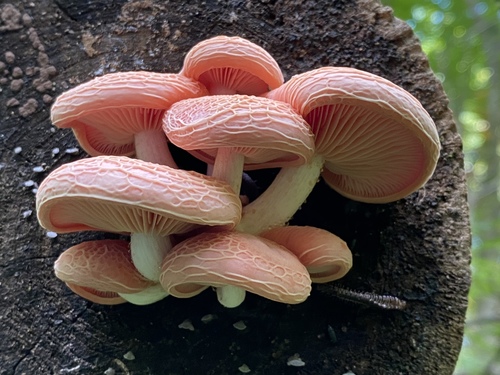
Rhodotus palmatus (Bull.) Maire produces fruit bodies that consist of a cap and a stem, with neither a ring nor a volva present. The cap starts out convex, becoming somewhat flatter as it matures, and typically grows 2–6 centimeters (0.8–2.4 inches) wide. The cap edges curve inwards, and its surface usually has a distinct network of pale ridges or veins that surround deep, narrow grooves or pits. This surface pattern is technically called sulcate or reticulate. The color of the surface between the ridges is somewhat variable, ranging from salmon-orange to pink to red depending on the lighting conditions the mushroom experienced during its development. The cap surface has a gelatinous texture, while the internal flesh is firm but rubbery, and pinkish in color. The gills attach adnately to the stem, meaning they are broadly attached to the stem across all or most of the gill width. The gills are thick, packed closely together, and share a similar veining structure and color to the cap, though the gill color is paler. Some gills do not run the full distance from the cap edge to the stem; these short gills, called lamellulae, are arranged into two to four groups of roughly equal length. The stem measures 1.5–3.0 cm (0.6–1.2 in) tall and 0.4–0.6 cm (0.16–0.24 in) thick, and it is usually slightly larger near its base. It can attach to the underside of the cap either centrally or laterally. Like cap color, stem size is also affected by the type of light the fruit body receives while maturing. In natural conditions, Rhodotus palmatus sometimes produces visible red or orange liquid in a phenomenon described as "bleeding". A similar observation has been made when the species is grown in laboratory petri dish culture: orange drops appear on the mat formed by fungal mycelia before the first fruit bodies begin to develop. Mature fruit bodies will turn green when exposed to a 10% aqueous solution of iron(II) sulfate (FeSO4), a standard iron salt test used for mushroom identification. Rhodotus palmatus is saprobic, meaning it gets nutrients from decomposing organic matter. It grows either scattered or in small clustered groups on rotting hardwood, including basswood, maple, and especially elm; it is also known to grow on horse chestnut in Europe. This mushroom prefers low-lying logs in areas that are periodically flooded and receive little sunlight, such as areas shaded by a forest canopy. It is a pioneer species in the fungal colonization of dead wood, and prefers to grow on relatively undecayed substrates. It is often found growing on dark-stained wood, particularly the dried-out upper parts of trunks that have lost their bark. R. palmatus usually fruits in cooler, moister weather: from spring to autumn in the United States, and from autumn to winter in Britain and Europe. The species has a circumboreal distribution, and has been reported from Iran, Hungary, Italy, Poland, Slovakia, Denmark, Sweden, Norway, Germany, the area that was formerly known as the USSR, Korea, Japan, New Zealand, Canada, and the eastern United States extending from Kansas to Virginia northward. While it is often described as "rare", a 1997 study indicates it may be relatively common in Illinois. It has been suggested that an increase in the number of dead elms from Dutch elm disease has helped the species make a comeback. Depending on the source, the edibility of Rhodotus palmatus is typically listed as either unknown or inedible. The species has no distinguishable odor, and is described as having a bitter taste, though one early report noted its taste was "sweet". In a Spanish research study testing the antimicrobial activity of mushrooms, R. palmatus was one of 204 species screened against a set of human clinical pathogens and laboratory control strains. Using a standard laboratory method to test antimicrobial susceptibility, the mushroom showed moderate antibacterial activity against Bacillus subtilis, and weak antifungal activity against both Saccharomyces cerevisiae and Aspergillus fumigatus.